
200hr Ashtanga Training · Study Two
Yoga Methodology
Practice first. Everything you will teach begins as something you have practiced. This study is the craft of the practice and the craft of teaching it.
Begin Here
Practice, then teach
This study is mainly about the practice and the teaching of asana. Practice first. Only by making the material your own will you become comfortable teaching it. We cover every posture in the Primary Series, how to practice each one and how to teach it. You may practice alone or in a class. If a vinyasa or a technique differs from the way your usual teacher does it, simply do as you are being taught and let it go.
Build an approach to yoga that is balanced, sustainable, and fits your life. Do something the moment you wake, even if it is very short and simple. That will shape you far more than attending public classes. Try to include three things in your daily practice whenever you can.
One · Therapeutic Movement
Study your own body and do something to bring it ease and balance. This can be anything, from self massage to somatic movement to any therapeutic exercise you sincerely find helpful. In times of injury, illness, or heavy stress, give this more time. When all is well, a few minutes will do.
Two · Asana
Do at least Sūrya Namaskāra each day. Three A salutations, three B salutations, and three finishing postures are a daily minimum that keeps asana alive in the body. Unlike therapeutic work, asana has structure. Learn the Primary Series and practice it as regularly as you can, ideally every day, resting on the new moon and the full moon.
Three · Pranayama and Meditation
After asana, take time to notice your inner world. There is no need to analyze it. Simply quiet the verbal mind as far as you can and rest there, even for a few seconds. This has its own way of taking us inward and giving us the insight we need. Concentration is difficult, and prāṇāyāma is the way to steady it. Study the prāṇāyāma course and use those techniques to gather the mind.
All of this takes as much time as you can give. A couple of hours a day is ideal. If you do not have that, do what you can and be grateful for it. The golden recipe is to practice at the same time, in the same place, every single day, without fail, over a long stretch. Even five minutes, kept faithfully, works, and it is worth your time.
The Practice
Asana
Our course covers the Primary Series. If you can keep up with the practice video and you have some experience, the Intermediate Series is here as well, in case you would like to try it.
Vinyasa, move by move
We go through the practice move by move and talk through the transitions. They are all built on Sūrya Namaskāra. The more precise and developed your Sūrya Namaskāra, the better your timing and your vinyasa will be. It is a great deal to hold at first, and only practice makes it natural. You will find it is a kind of logic, and once you have a foundation it becomes intuitive.
Teaching
Teaching the postures
Teaching the postures is a natural evolution of practicing them. To absorb this part of the course you will need some hands on experience. That can be as simple as doing yoga with a friend once a week and asking to try your new techniques on them. Studios always need substitute teachers, which is another good way in. No training in the world can fully prepare you for standing in front of people and leading a class. At some point you simply make the jump and try. Even a class that goes badly by your own reckoning teaches you a great deal, and it can be joyful and rewarding.
As a student, you share what you know with people who have not yet learned it. That is all teaching ever is, whether it is your first class or your thousandth. Look for a chance to share. Join the Sunday classes online when your time zone allows, and see how I teach in a live setting. Come to the live training weekends and watch others work through the adjustments and the verbal cues. The only bad teacher is one who harms another, or one who is too afraid to begin.
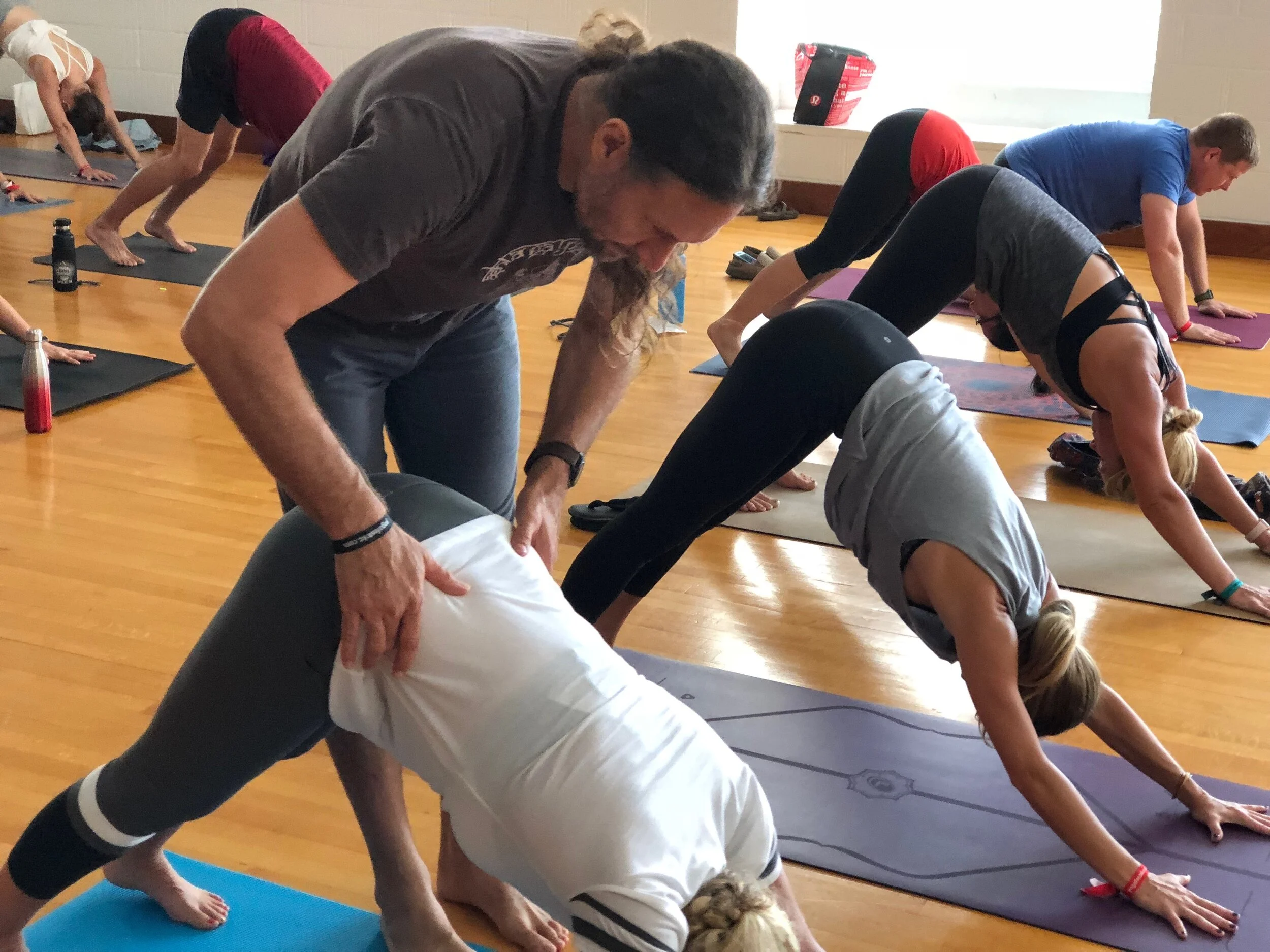
Adjusting the postures
Watch me work with students, and then watch others learning to give the adjustments themselves. Seeing the same posture met in different bodies is where the real understanding starts.
Going Inward
Pranayama and Mudra
When you are grounded in asana, and the body has been steadied and cleared to some degree, you are ready for the next stages of yoga. Prāṇāyāma is the bridge from the physical practices to the inner, contemplative ones. It is still a physical practice, yet it opens into states where the deeper aspects of yoga can be understood and felt. Keep a regular practice at the same time and place each day, and work through the entire prāṇāyāma course with care. We would like to take you well past the mechanics of the postures, into the energetic and internal life of yoga, through mudrā and prāṇāyāma.
The Pranayama Course
Mudrā and prāṇāyāma are taught in full in the Pranayama course, which is included with your place in the program. Open it below. If you need the access code, write to Andrew and he will send it to you.
The Psychology of Teaching
Relating to students
Teaching is a relationship before it is a transmission. The aim is to meet each student with unconditional positive regard, to stay honest and fully yourself, and to pass the practice on accurately, without adding yourself where you are not needed. These talks look at how to relate to the people in front of you, how to hold your own authenticity as a teacher, and how to keep the transmission clean.
Nine things you should avoid talking about with yoga students
Other Teachers
Practice with my friends
Bryce Delbridge
Bryce Delbridge is my old friend and student. I first met him when he was a baby, our parents were old friends. At fifteen he was diagnosed with severe scoliosis, and he took up a rigorous yoga practice to avoid having rods fused to his spine. He is now a master teacher and practitioner. In these videos he shows techniques any of us can use to grow strong and light, and to build the abilities that vinyasa asks for, whether you are far from the arm balances or already deep in them.
- Step by step, how to become light and strong enough for the handstand and arm balance postures.
- How to use sliding movements to build strength.
- How the cat and cow movement assists the floating transitions.
- Common questions that come up in this part of practice.
The therapeutic side of Bryce's work, injury prevention, self massage, and counterbalance, lives in Physiology and Healing Arts.
Mila Rybakova Eppler
In this series Mila Rybakova Eppler teaches grounding and stabilizing the spine through the bandhas, in an approach to asana quite different from vinyasa. The longer holds and the close attention to alignment deepen your understanding of the postures.
More teachers, more perspectives
Asana is an infinite art. I can only give you my own limited understanding of it. By practicing with other teachers you gain more exposure and other points of view. The teachers gathered here are dear friends I respect deeply. They have all practiced for many years and taught well in their own countries and cultures. Some teach Ashtanga sequences and some do not, and you will see the influence of Ashtanga in all of their work. Practice along, and enjoy the different perspectives.
Keep Going
Practice, then teach what you have practiced
The work of this study is simple to say and long to live. Take your time with it, and let the practice and the teaching shape each other. When you are ready, step back onto the mat.
Questions along the way: andrew@ashtangayogastudio.com