Katha Upanishad
An Online Philosophy Course with Dr. H. V. Nagaraj Rao
This is one of the most profound philosophical texts. It is truly the education of a yogi.
The Katha Upanishad stands as one of the most revered and profound texts in the tradition of Indian philosophy, offering timeless insights into the nature of reality, the self, and the path to liberation (moksha). Through the dialogue between Nachiketa, a young seeker, and Yama, the god of death, the text reveals essential teachings on the impermanence of the material world, the eternal nature of the soul (Atman), and the ultimate truth of Brahman. At its core, the Katha Upanishad underscores the importance of spiritual inquiry, self-mastery, and the direct experience of the self as the key to attaining true freedom from suffering and the cycle of birth and death (samsara).
This course delves into the profound teachings of the Katha Upanishad, guiding participants through its key themes and metaphors. It will explore the nature of human existence, the duality of worldly pleasures and spiritual wisdom, the nature of the Atman, and the path to self-realization. The course will also examine the relevance of the Upanishad’s teachings in contemporary life, providing practical insights for those seeking spiritual growth and liberation.
By engaging with the text, students will embark on a transformative journey towards deeper self-awareness, cultivating wisdom to transcend the distractions of the material world and embrace the eternal truths of the self and the universe.
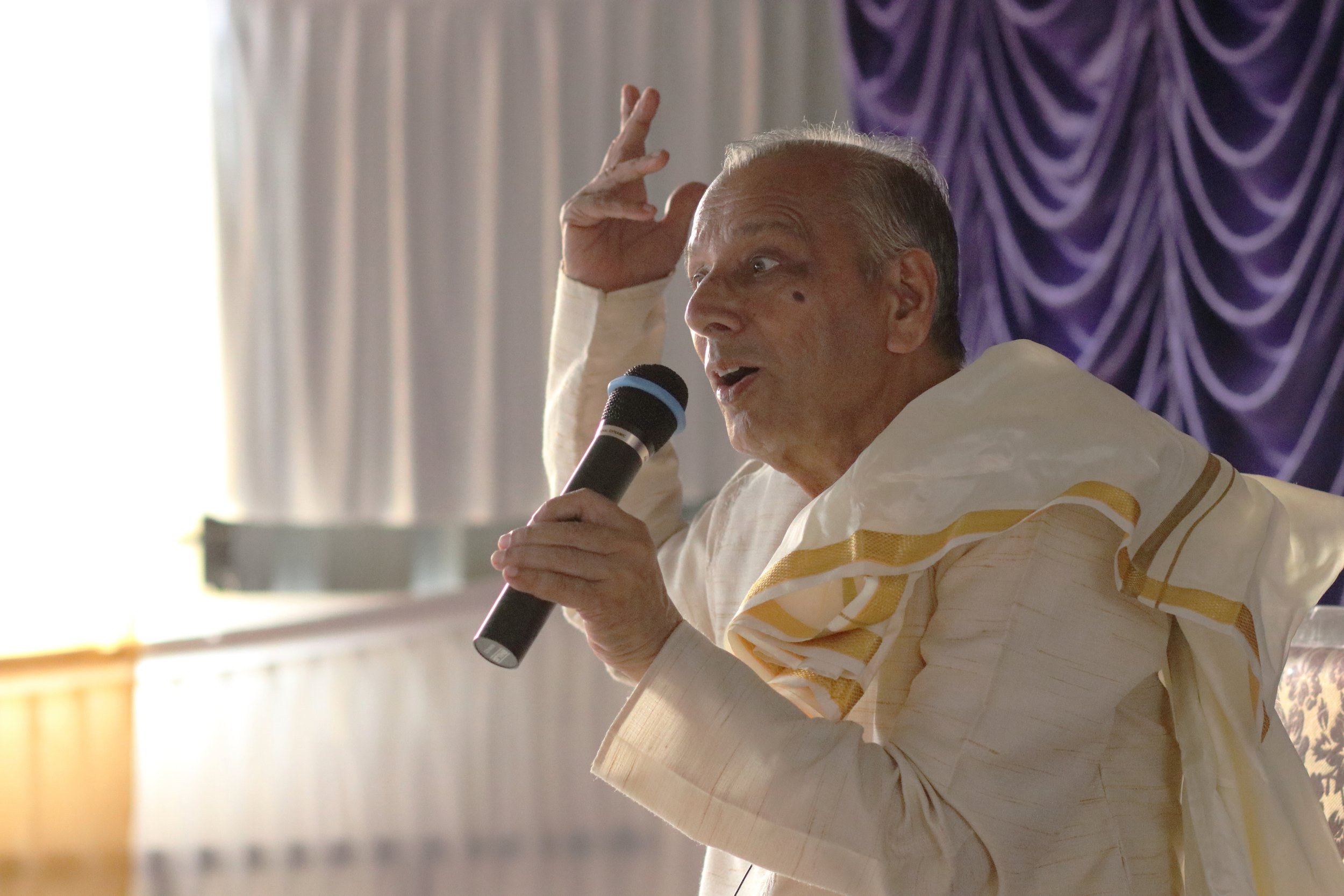
Our instructor, Dr. Rao, is not your ordinary Sanskrit scholar. He is a shining star from Mysore, and we consider it an honor to share his knowledge with the world. With his razor sharp wit and light hearted humor, he is one of our favorite teachers. Through this journey into Indian philosophy, your understanding of life, human experience, and yoga will be enriched. We have full confidence that this lecture series will be a profound experience for everyone who attends.
Learning from a great scholar like Dr. Rao offers a whole new perspective. When we study Indian Philosophy with someone who has a lifetime of experience and a deep understanding of cross-references from other texts and traditional interpretations, the experience becomes a direct transmission of knowledge, world view, and life experience.
The great texts of India are vast, and our knowledge and perspective are limited. We often focus on what we can understand and relate to, but in doing so, we might miss many other valuable aspects. By embarking on this journey with a seasoned scholar, we open ourselves up to a broader and richer understanding that goes beyond our preconceptions. It's an opportunity for a transformative experience that will leave a lasting impact on your spiritual growth and outlook on life.
Download the Katha Upanishad Text
Lesson 1 – Introduction to the Kaṭha Upaniṣad
The Śānti Mantra: saha nāv avatu
At the beginning of our study of the Kaṭha Upaniṣad, we recite the well-known śānti mantra “saha nāv avatu.” This mantra is traditionally associated with the Kaṭha Upaniṣad and is chanted as an invocation before teacher and student begin their dialogue.
The essence of this mantra is a shared prayer: “Let us be protected, let us be nourished, let us work together with great energy, and let our study be filled with clarity and harmony.” In simple terms, it expresses the wish that teacher and student are both protected and that there is clear communication between them. Without this atmosphere of mutual protection and understanding, the subtle teachings of the Upaniṣads cannot truly be received.
The Aim of the Upaniṣads
The Upaniṣads, including the Kaṭha Upaniṣad, are deeply concerned with defining and understanding the nature of the soul. They are not merely philosophical speculations; they are practical teachings meant to illuminate the reality of who we truly are.
The primary intention of all the Upaniṣads is to bring forth human beings’ innate power and intelligence. They assume that within each person there is a hidden greatness—clarity, courage, discernment, and spiritual strength—that is usually covered over by ignorance and distraction. Through careful listening, reflection, and contemplation, this hidden power is awakened.
Three Fundamental Principles: jīvātman, World, and God
In this vision, three fundamental principles are highlighted:
The first principle is jīvātman, the individual soul. This is the conscious being who experiences pleasure and pain, who thinks, feels, and acts. The jīvātman is the “I” that we ordinarily identify with, but whose deeper nature we do not fully understand.
The second principle is the material world. This includes the body, the senses, and the entire field of experience—objects, situations, and all the changing phenomena around us. It is the environment in which the jīvātman moves and acts.
The third principle is the controlling power, God, who may be called by any name. This is the universal higher power that orders, sustains, and governs the whole cosmos. Different traditions may use different names and concepts, but here the idea is of a single, universal governing intelligence.
The Upaniṣadic teaching unfolds by clarifying the relationship between these three: the individual soul, the world, and the supreme controlling reality.
Caitanya: The Life Force
At the heart of this vision is caitanya, the principle of consciousness or life force. Caitanya is what makes the body alive, the senses function, and the mind think. It is not merely physical energy; it is the subtle presence that makes awareness possible.
When we say “caitanya is life force,” we are pointing to that inner luminosity that allows us to know, feel, and respond. The Upaniṣads ultimately affirm that this caitanya is not separate from the deepest reality of the self and, in a higher sense, is not separate from the divine.
The Human Condition: Trivial Pursuits and Rare Seekers
Most human beings, the Upaniṣads observe, run after meaningless, trivial pleasures. They chase small enjoyments, temporary excitements, and shallow satisfactions, rarely pausing to inquire into the deeper meaning of life. Time and energy are expended on external things, while the inner reality remains unexplored.
Only a few people choose to go deeply into spiritual practice. These rare seekers turn away, at least inwardly, from trivial pursuits and direct their attention to the fundamental questions: Who am I? What is death? What is the purpose of this life? What is truly permanent and reliable in this changing world?
The Kaṭha Upaniṣad is addressed especially to such seekers.
Ignorance and Suffering
According to this teaching, ignorance of the reality of one’s own self is the root cause of all suffering. When we do not know who we really are, we mistake the body, the mind, and the ever-changing world for the self. This confusion leads to fear, attachment, anxiety, and endless dissatisfaction.
The Upaniṣads, therefore, do not merely give comforting ideas; they attempt to remove ignorance by pointing directly to the true nature of the self. When ignorance about the self is dispelled, suffering loses its foundation.
The Kaṭha Upaniṣad: A Secret Teaching on Life and Death
The Kaṭha Upaniṣad is described as a text that tells the secrets of life as handed down by great teachers from ancient times. Its teachings have been preserved and respected over generations, precisely because they address the most profound human concerns: the meaning of life, the reality of death, and the possibility of liberation.
Many great Indian scholars have written commentaries on this work. Each commentator, standing in a lineage of teachers, has sought to clarify and unfold its subtle meanings. This long tradition of commentary shows how central and revered the Kaṭha Upaniṣad has been in Indian thought.
Naciketas and Yama: The Teacher–Student Pair
At the center of the Kaṭha Upaniṣad is the dialogue between a young student named Naciketas and Yama, the god of death.
Naciketas is a young boy, but the Upaniṣad presents him as a sincere and courageous seeker of truth. Yama, although known as the god of death, appears here as a compassionate teacher, capable of imparting the highest knowledge.
Their encounter forms the frame through which the teachings of the Upaniṣad are presented.
The Story Begins: The Father’s Ritual and the Boy’s Question
The story opens with Naciketas’ father performing a ritual sacrifice. In this ritual, the father is expected to give gifts in a spirit of genuine generosity. However, the boy observes something that troubles him—perhaps the gifts are not of the quality they should be, or the intention behind them is questionable.
In the course of this situation, the boy interrupts his father. Annoyed and angered by his son’s questioning, the father reacts harshly and, in a moment of anger, declares that he will give his son to the god of death. This is a very serious statement, especially in the context of a sacred ritual.
A little later, the father regrets what he has said and tries to take it back. But Naciketas insists that a promise given in the context of a ritual is not to be treated lightly. He says, in effect, “A promise is a promise.” His commitment to truth and to the integrity of the ritual is already visible here.
Journey to the House of Death
Because of these events, Naciketas in some way goes to the house of death. The Upaniṣad does not present this as a mere fantasy; rather, it uses this narrative to place the young seeker face to face with Yama himself.
When Naciketas arrives at Yama’s abode, Yama is not at home. According to the story, Naciketas waits outside, refusing to accept hospitality in Yama’s absence. He sits patiently, without food or water, for three days and three nights.
The Law of Hospitality in Indian Culture
In traditional Indian culture, hospitality is considered sacred. To neglect a guest—especially one who comes with sincerity—is seen as a grave mistake. To keep a guest hungry and thirsty, without offering the basic courtesies of food, water, and shelter, is an even greater fault.
Therefore, when Yama returns and discovers that Naciketas has been waiting outside his house for three days and three nights without being fed, he is deeply concerned. He recognizes that he has failed in his duty as a host.
Because of this failure, Yama feels compelled to make amends. To compensate for the suffering that Naciketas has undergone while waiting, he decides to offer the boy three wishes or boons—one for each day that he waited in hunger and thirst.
This episode illustrates a powerful cultural lesson: we should always remember the law of hospitality whenever any kind of guest arrives at our home. To welcome, feed, and care for a guest is not just good manners; it is regarded as a sacred responsibility.
The Three Boons
Thus, for the three days and three nights that Naciketas waited at the doorway of death, Yama offers him three boons. This becomes the turning point of the narrative: through these boons, Naciketas will eventually seek not only worldly reassurance but, most importantly, the highest spiritual knowledge about the reality beyond death.
In this first lesson, we stop at the threshold of that dialogue. We see how the story is set up: a young boy of integrity, a father’s rash promise, the journey to the house of death, the waiting without hospitality, and the god of death moved to grant three wishes in order to correct his mistake.
Conclusion: Setting the Stage for Deeper Teaching
This is the beginning of the story of the Kaṭha Upaniṣad. It prepares us for the profound questions that will follow. Already in this opening section, several key themes are present:
The sacred relationship between teacher and student, invoked by the mantra “saha nāv avatu,” asking for protection and clear communication.
The Upaniṣadic aim of defining the soul and awakening our inner power and intelligence.
The three principles of jīvātman, the material world, and the controlling power, God, understood as a universal higher reality.
The central place of caitanya, the life force that makes awareness and experience possible.
The insight that most people chase trivial pleasures while only a few turn toward serious spiritual practice.
The teaching that ignorance of our true self is the source of all suffering.
The narrative framework of Naciketas and Yama, and the powerful cultural law of hospitality that leads to the granting of three boons.
With this background, we are ready to move further into the dialogue between Naciketas and Yama, where the Kaṭha Upaniṣad begins to unfold its deep reflections on life, death, and the immortal self.
Lesson 2 – The Three Boons of Naciketas
The Beginning of the Dialogue with Yama
In the second lesson of the Kaṭha Upaniṣad narrative, the true heart of the text begins to unfold. Naciketas has reached the abode of Yama, the god of death, and after waiting three days and three nights without hospitality, he has been granted three boons in compensation. Now the conversation between Naciketas and Yama begins, and each boon reveals something about the priorities and maturity of this remarkable young seeker.
The First Boon: Reconciliation with the Father
For his first boon, Naciketas does not ask for wealth, power, or special powers. Instead, he asks for harmony in his own family. His first wish is that his father should love him and welcome him back with affection and good feelings. He wants to be received back by his father with a peaceful heart and restored relationship.
Yama readily grants this wish. The first boon thus restores emotional and familial harmony. It shows that Naciketas understands the importance of reconciliation and love in the human realm, even as he is about to inquire into the deepest spiritual truths.
The Second Boon: Knowledge of Heaven and the Sacrificial Ritual
For his second boon, Naciketas turns his attention to a higher goal: he wishes to attain heaven. He asks for the knowledge of a ritual that leads to a heavenly state where there is no fear of death, no old age, no hunger, and no thirst. In that heavenly realm, suffering as we know it is absent. Naciketas requests that Yama teach him a simple sacrifice or ritual by which heaven can be reached.
Yama agrees and gives him this ritual teaching. Naciketas is an exceptional student: he learns the ritual immediately and can perform it right away. His grasp of the instruction is so complete that Yama tells him that this ritual will be remembered forever and will be known by Naciketas’ own name. In other words, the sacrificial rite will be called the “Naciketas fire” and will carry his name into future generations.
Yama is so pleased with Naciketas’ understanding and capacity that he takes off a diamond necklace and gives it to him. This gesture shows Yama’s appreciation and also symbolically honors the purity and brilliance of Naciketas’ intellect and character.
At this point, two boons have been granted: harmony with the father, and the knowledge of a ritual that leads to heaven. Now comes the crucial third boon.
The Third Boon: The Question of Death and the Soul
For his third wish, Naciketas does not ask for anything ordinary. He asks the most difficult and profound question that human beings can raise.
He says that when a man is leaving his body—when death approaches—there is a doubt as to whether he continues to exist or not. Some say that something remains, others say that nothing remains. There is great disagreement.
Some say there is a permanent soul which continues its journey, going to heaven or hell and eventually being reborn. Others deny this and argue that there is no enduring self beyond the body and mind. Naciketas asks Yama directly: “Please teach me about this.”
This third boon is the request for the secret concerning death itself: Is there something that survives the death of the body? What is the nature of that reality? This is the central question of the Kaṭha Upaniṣad.
Yama’s Reluctance and Attempt to Divert Naciketas
Yama does not immediately answer this question. Even though he is the god of death and the natural authority on this subject, he hesitates. He does not want to answer the question right away. He tries to avoid the topic and distract Naciketas.
One reason given is that Yama is not sure whether Naciketas is truly serious and ready for this knowledge. The teaching about the soul and the reality beyond death is not casual information. It requires great maturity and sincerity from the student, or else it can be misunderstood and misused.
So Yama discourages Naciketas from holding on to this third wish. He suggests that Naciketas ask for something else instead. This reluctance itself shows how profound and sacred the knowledge is.
The Temptations Offered by Yama
Yama then begins to propose alternative boons. He suggests that Naciketas ask for good things in the worldly sense: material success, large numbers of offspring, herds of cows, gold, wealth, and every kind of prosperity. He tells Naciketas not to “waste” his last wish on such a difficult and subtle question.
Yama goes further and shows him all kinds of pleasures and attractions. He offers beautiful girls, castles, gold, long life, and the granting of all desires. In short, Yama places before Naciketas everything that human beings ordinarily dream of: sensual pleasures, power, security, and worldly greatness.
This is not merely a test of desire; it is a test of discernment. Yama is essentially asking: “Is your longing for knowledge of the eternal stronger than your attraction to temporary enjoyments?”
The Steadfastness and Wisdom of Naciketas
Naciketas’ response shows his greatness. He listens to all of Yama’s offers and then calmly rejects them.
He points out that Yama may indeed grant these pleasures, but they are all limited by time. He asks, “How long will I live to enjoy them?” He sees clearly that all pleasures are impermanent and will inevitably vanish. Everything that is enjoyed through the senses is subject to change, decay, and loss. When such pleasures are pursued in excess, they ultimately cause misery.
Naciketas says that he does not want these things. He declares that he cannot be satisfied by them. He says he is not worried about what he has or does not have. Even if he were to live for a thousand years, he reflects, he would only be watching his children and grandchildren die, again and again. Long life, without deeper understanding, merely extends the cycle of sorrow.
He rejects all offers of entertainment, enjoyment, and worldly greatness, and returns firmly to his original question, insisting: “Tell me the answer to my question. What is the secret of death? That is my wish and nothing else.”
He adds that it is Yama’s duty to enlighten him. As the god of death, Yama is uniquely qualified to explain what happens when the body falls, and Naciketas appeals to this responsibility. In doing so, Naciketas shows that he is not a casual questioner; he is a committed seeker, prepared to give up every other advantage for the sake of truth.
Only Naciketas, it is said, could give such a firm and uncompromising answer. This is why he is regarded as one of the greatest of students in the Upaniṣadic tradition.
The Philosophical Framework: Three Principles Revisited
At the end of this teaching segment, we are reminded of the three basic principles that underlie all philosophical inquiry:
There is the individual soul (jīvātman), the conscious being who experiences life.
There is the material world, the field of change, including the body, senses, and external objects.
There is the controlling power, the higher reality or God, which governs and sustains all.
All philosophical views, in one way or another, deal with these three principles. The Kaṭha Upaniṣad uses the dialogue between Naciketas and Yama to explore their relationships: What is the true nature of the individual soul? How is it related to the material world? How does it stand in relation to the controlling power, the ultimate reality?
In this second lesson, the stage is now fully set. Naciketas has obtained two important boons related to family peace and heavenly attainment. But he has refused every worldly and heavenly temptation in order to pursue the ultimate question about the soul and death. Yama has tested him and found him steadfast.
From this point, the Upaniṣad is ready to reveal the deeper teaching about the self that neither dies nor decays, the reality that stands beyond all change.
Lesson 3 – The Two Paths and the Nature of Desire
Yama Begins His Teaching on Death
In this third lesson, Yama finally begins to answer Naciketas’ question about death. Before explaining the mystery directly, he first describes the fundamental choice that confronts every human being. The teaching does not begin with abstract theory; it begins with a practical distinction that shapes the whole destiny of a person.
Two Paths Before Every Human Being
Yama explains that there are two basic paths in life:
One path is attractive and easy.
The other path is hard and challenging.
The soul is always drawn toward one of these two directions. On one side is sense enjoyment and material fulfilment, the pursuit of comfort, pleasure, and worldly success. On the other side is the spiritual path, which is concerned with the evolution of consciousness and the discovery of our true nature.
If a person chooses the right path—the path of inner growth—he or she will succeed in every way that truly matters. If a person chooses only the easy, attractive path of immediate pleasure, then failure, in the deeper sense, is inevitable.
Naciketas himself had already faced this choice when Yama offered him wealth, fame, possessions, long life, and every kind of enjoyment. By refusing these offers and insisting on the knowledge of truth, Naciketas earned Yama’s respect and earned his right to receive the real teaching.
Success and Failure: Short-Term Comfort vs Long-Term Vision
Yama’s teaching is very clear and uncompromising. A person who is attracted only by momentary pleasures and what is comfortable can never truly succeed. Such a person avoids effort and discipline, sacrifices long-term well-being for short-term gratification, and remains spiritually immature.
By contrast, a person who is diligent and steadfast, who keeps his eyes on long-term goals and accepts discipline, will always succeed. This success is not merely external; it includes inner stability, clarity, and growth in wisdom. The Kaṭha Upaniṣad uses Naciketas as the model of such a diligent seeker.
Desire as the Chain of Bondage
At the root of this problem is desire. Yama states that desire is what binds us to suffering. The mind runs again and again toward objects, experiences, and status, imagining that fulfillment lies there. In reality, this movement never ends.
The text emphasizes that almost everyone falls into this trap: “99.99% of everyone” is drawn into material desires. The desire for sense gratification and materialism is overwhelmingly dominant in the world. It is so pervasive that most people do not even recognize it as a problem.
Vidyā and Avidyā: Knowledge and Ignorance
Here the Upaniṣadic distinction becomes central:
vidyā is knowledge—true insight into reality, especially into the nature of the self.
avidyā is ignorance—mistaking the non-self for the self, taking the impermanent as permanent, and confusing pleasure with real happiness.
Naciketas stands firmly on the side of vidyā. He is deeply interested in knowledge, not in temporary enjoyment. He insists that all pleasures last only for a moment, and therefore cannot satisfy the deepest longing of the soul. He demands from Yama not entertainment, but the truth about life and death.
Darkness and Delusion in the World
Yama’s description of ordinary human life is sharp and unsparing. Most people do not know who they are or what their purpose in life is. They only pursue comfort and enjoyment. They are in darkness.
The most striking part of this criticism is that such people believe themselves to be very intelligent in this pursuit. They consider their cleverness in acquiring comfort as a sign of wisdom. But from the standpoint of the Upaniṣads, they are deluded.
When a person rises to a powerful position, another danger arises. People around him begin to flatter him. If he believes this flattery, he becomes even more deluded and drifts further and further away from reality. The more he is praised, the more he loses touch with his true self.
The text describes such people as fools who have cheated themselves while imagining that they are the most intelligent. They are like the blind being led by the blind. For such people, misfortune is inevitable, because their whole orientation is based on error.
The Continuous Chain of Error
Once a person becomes a slave to material desire, a continuous chain of errors begins. One wrong assumption leads to another, and the person moves further away from wisdom.
No one can satisfy the endless desires that arise in the mind. The more we feed them, the more they grow. This endless craving arises from a basic belief: that what can be seen is all that exists, that only the visible and tangible world is real. When we limit reality in this way, we naturally try to squeeze all possible enjoyment out of the material world, and this becomes a source of unending frustration.
The Frog in the Well: Expanding Our Vision
To illustrate this limitation, the image of the “frog in a well” is given. A frog that lives only in a small well believes that the well is the entire universe. It is completely ignorant of lakes, rivers, oceans, and the vastness of the world outside.
In the same way, a person whose mind is confined to material desires is deluded about the true scope of life. When the frog comes out of the well, its vision expands. For us also, our view of life can expand beyond narrow materialism.
Only when one begins to see with the “inner eye” can one escape from the pull of desire. This inner eye is the eye of wisdom, opened by yoga and spiritual practice.
The Secret of Yoga: Often Proclaimed, Rarely Heard
Yama points out that this secret of yoga—the transformation of vision through inner awareness—has been proclaimed by seers and yogins for thousands of years. The message is not new; it is ancient and well tested.
Yet, he says, no one listens. The world is so complex, engaging, and distracting that most people feel they have no time or energy for spirituality. Even when people hear such teachings, they do not truly understand. Sometimes it even makes them angry, because it challenges their habits and attachments.
They remain interested in trivial things and fleeting pleasures. The higher teaching appears irrelevant or uncomfortable, and so they turn away.
The Cost of Liberation: Nothing Worth Having Is Cheap
For the sincere spiritual aspirant, this situation is both a warning and an encouragement. Yama states clearly that a spiritual aspirant has to work for true growth. Anything worth having is not cheap. Only sincere, continuous effort can bring real evolution and liberation from the constant ups and downs of material life.
The message is simple: if we want something permanent and meaningful, we must pay the price in discipline, reflection, and inner effort. Naciketas himself is the living example of this principle.
A Rare and Blessed Meeting: True Teacher and True Student
The Upaniṣadic tradition emphasizes that it is a very special and blessed occasion when two conditions come together:
An intelligent person who has true knowledge and is capable of sharing it.
Another person who is truly interested and capable of receiving this knowledge.
When an experienced teacher and a sincere student meet, something powerful can happen. Yama and Naciketas together represent this ideal: the god of death, who knows the truth, and the fearless young seeker, who is ready to hear it.
The Need for Living Experience and Initiation
A teacher who tries to communicate such teachings without personal experience and conviction cannot succeed. Mere reading of texts is not enough. One may repeat the words, but without inner realization the teaching lacks life and transformative power.
The Upaniṣads suggest that to truly enter into these ways of seeing life, one must be initiated. This initiation is not just a ritual; it is a living transmission from one who has seen to one who is ready to see. The teacher must have “walked the path,” and the student must be prepared to follow.
The Limits of Reason and the Nature of True Knowledge
Can a person understand the highest truth by rational thinking alone? The Upaniṣads give a firm “no.” Reason has its place, but it cannot cross the boundary into direct realization.
One has to experience the truth. Only a person with that experience can speak about these matters in a way that carries real authority. Intellectual discussion can point in the right direction, but it cannot substitute for direct insight.
If we have money, we can buy books. But knowledge is different. Books and people can give us information, but knowledge in the deepest sense requires personal effort, reflection, and inner transformation.
Impermanent and Permanent: What Can and Cannot Be Gained
All the things we can acquire in this world through money, power, and influence are temporary. They are constantly changing and will eventually be lost. From impermanent things one cannot obtain something that is permanent.
True knowledge—insight into the nature of the self and reality—is of a different order. This knowledge is lasting. Once gained, it does not disappear with the rise and fall of circumstances. Information comes from outside and can be forgotten; knowledge is internalized and becomes part of one’s being.
Cārvāka: The Voice of Materialism
As a contrast to the Upaniṣadic perspective, the tradition mentions the school of Cārvāka, which represents materialism. Cārvāka philosophers deny any reality beyond the physical world and advocate enjoyment of this life as the highest goal. Such ideas are mentioned, for example, in the Rāmāyaṇa and in many places throughout Indian literature.
By referring to Cārvāka, the tradition shows that the debate between materialism and spiritual vision is ancient. The Kaṭha Upaniṣad clearly stands on the side of those who seek something beyond the visible world.
Yama’s Love for Naciketas
In the end, Yama is deeply pleased with Naciketas. He loves him and his question so much that he praises him and rejoices in the great opportunity that has arisen. Here is a student who refuses to be deceived by temporary pleasures, who is not frightened by the topic of death, and who is ready to listen to the truth, however challenging.
Because of this, Yama is now willing to open the deeper teaching. The dialogue that follows will reveal what happens after death, what the soul really is, and how one can become free from the cycle of suffering.
Lesson 4 – Śreyas and Preyas: The Higher and Lower Paths
The Ongoing Dialogue: The Mystery of Death Deepens
The conversation between Naciketas and Yama continues, and the mystery of death is explored at a deeper level. Naciketas has refused wealth, fame, and every kind of material comfort, asking instead for knowledge of what lies beyond death. In response, Yama begins to unfold the inner structure of the spiritual path.
Śreyas and Preyas: Two Fundamental Options
Yama introduces a crucial distinction: there are two options available to every human being—śreyas and preyas.
Preyas is that which is pleasing in the moment. It gives immediate comfort and enjoyment, but ultimately drags us down. It binds the soul more tightly to ignorance and repeated suffering.
Śreyas is that which truly takes us forward, the choice that leads to growth and evolution. It is rarely easy at the time. Śreyas may demand sacrifice, discipline, and effort, but it elevates the soul and brings lasting benefit.
Naciketas has already demonstrated his allegiance to śreyas. When Yama offered him fame, wealth, and all kinds of material pleasures, he refused them and asked for knowledge instead. By doing so, he aligned himself with the higher path and showed that he was worthy of receiving the deepest teaching.
Hidden Truths and the Role of Yoga
Yama explains that some truths are hidden and not easily accessible. They are not locked away from any particular group of people; in principle, they are available to everyone. However, they require great effort to access. Casual curiosity is not enough.
Yoga is presented as the way in which those truths can be accessed. In its most fundamental sense, yoga means “to join” or “to yoke.” It is the great process by which the individual soul is joined to its true source, and by which the seeker inquires into the nature of the ātman.
The individual soul takes birth in this world without clear knowledge of the purpose of life. The great questions—Who am I? Why am I here? What is death?—are not answered for us automatically. Unless we make the effort to study and practice, they remain unresolved. Yoga is this effort of inquiry, discipline, and inner integration.
Yama tells Naciketas that only by yoga and by approaching the divine can he receive the answer to his great question about death. Without that approach to divinity, the highest truth remains out of reach.
The Subtle Reality: Smaller than an Atom, Larger than the Sky
Yama points to a very subtle reality that must be understood. He describes it as something “smaller than an atom and larger than the sky.” This paradoxical language indicates that the truth about the self cannot be measured or grasped by ordinary categories.
This reality is subtle, all-pervading, and beyond the usual frameworks of thought. Yama also speaks of a state that goes beyond pleasure and pain, a state that must be attained if one is to understand death and transcend it. The teaching is not only about ideas; it is about entering a state of consciousness that is untouched by dualities.
Yama explains these things to Naciketas, but Naciketas does not yet understand them clearly. He therefore asks further questions.
Beyond Good and Evil: Naciketas’ Deeper Question
Naciketas now inquires about good and evil. He asks not just what is good and what is evil, but what lies beyond good and evil altogether. He wants to know:
What is that reality which is beyond virtue and vice?
What is that higher truth that transcends all moral opposites?
This is an extremely subtle and demanding question. Naciketas is not satisfied with a simple moral teaching; he wants to know the ground on which good and evil themselves stand.
The Aim of the Vedas and Upaniṣads
Yama responds by acknowledging the depth of Naciketas’ inquiry. He says, in effect: “You are asking about the very thing that all great yogins and wise men are trying to understand.”
He further explains that the Vedas themselves are directed toward this truth. All the ritual, recitation, and reflection found in the Vedic tradition ultimately aim at realizing this one great principle. The Upaniṣads are especially focused on expressing it as clearly as possible.
Yama emphasizes that this knowledge is not easy to grasp for anyone, from any culture. It is not limited by geography or tradition; wherever one is born, this highest truth demands a refined and prepared mind.
Tapas, Study, and the Discipline of Yama and Niyama
To approach this truth, certain disciplines are essential. Yama mentions tapas, the discipline of austerity or deliberate self-restraint. He also highlights the importance of study—engaging deeply with the scriptures and teachings.
Alongside tapas and study, the disciplines of yama and niyama are crucial. Yamas are ethical restraints (such as non-violence, truthfulness, and non-greed), while niyamas are observances (such as purity, contentment, and self-study). Together, they help to clean the mind and heart.
Cleaning the inner instrument—the mind, heart, and intellect—is necessary for acquiring the highest truth. This purification is the purpose of all genuine spiritual practices. Without purification, the subtle reality remains obscured, no matter how much one reads or hears.
Yama notes that this great truth has been debated since time immemorial. Sages have reflected, discussed, and argued about it for countless generations, yet it remains ever-fresh and ever-demanding.
Īśvara and the Meaning of Oṃ
Yama then names this great truth: it is called Īśvara, the master or controller of the world. Īśvara is pure consciousness. He is not bound by karma; actions and their results do not limit or condition him. He is the unchanging principle behind all change.
The primal sound that expresses this great truth is oṃ. All the Upaniṣads are, in a sense, attempts to unfold the meaning of oṃ. This single syllable is treated as the essence of the Vedic revelation.
Yama gives a symbolic explanation of the components of oṃ:
“A” represents the waking state.
“U” represents the dream state.
“M” represents the transcendental state, often associated with deep sleep and the causal condition.
The resonant sound that lingers after the pronunciation of oṃ symbolizes liberation. It points to samādhi, the state of complete absorption in the highest reality. Thus, even the sound-structure of oṃ is used as a map of consciousness.
With this one word, oṃ, Yama is trying to express the great truth to Naciketas in the most compact and profound way possible.
Oṃ as the Support for Realization
Yama further explains this truth with a powerful image: like an anvil, the great reality stands unchanged behind all activity. A blacksmith shapes steel on the anvil; the hammer falls, the metal bends and transforms, but the anvil itself remains unmoved.
In the same way, the entire world of actions, changes, and events is shaped and reshaped upon the unchanging principle of Īśvara, or pure consciousness. Everything is “beaten out” upon that support, but the support never changes.
To understand that unchanging principle is the very knowledge that Yama is trying to give. Oṃ is described as the best support for this knowledge. Meditation on oṃ, rightly understood, becomes a direct means to realize the ātman and the supreme.
Oṃkāra upāsanā is the devoted contemplation or worship of oṃ alone, without any form. It is a formless, subtle practice that leads to knowledge of the ātman, knowledge of God, and knowledge of the eternal truth behind all life. This truth is that which is not born and does not die.
Eternal Consciousness and the Question of the Soul’s Origin
At this point, the crucial question is clearly framed: From where did the soul come?
The Upaniṣadic teaching points to a reality that is permanent, always aware, and without beginning or end. This is the question about the nature of eternal consciousness. Naciketas wants to know not only what survives death, but what that survivor truly is.
Yama’s teaching reveals that the real self is not a temporary product of the body, nor a passing configuration of matter, but a manifestation of this eternal consciousness that is neither created nor destroyed.
The Bhagavad Gītā as the Essence of the Upaniṣads
To help situate this teaching, a beautiful traditional comparison is given. The Bhagavad Gītā is described as the milk that comes from the cows of the Upaniṣads. The Upaniṣads are like cows full of nourishing wisdom. The Gītā is the milk extracted from them—sweet, concentrated, and easier to assimilate.
In this way, the Bhagavad Gītā is a summary of these great texts. It expresses their essence in a more compact and practical form. When we study the Kaṭha Upaniṣad and then see the teachings of the Gītā, we can recognize the same truths presented in different ways.
Seeing Through Appearances: Death, Virtue, and Vice
The ultimate purpose of all this teaching is to help one see the reality behind all appearances. When this reality is understood, death is seen for what it truly is—an event that happens to the body, not to the soul.
To realize the eternal ātman is to go beyond the fear of death. It is also to go beyond the strict oppositions of virtue and vice, good and evil, which belong to the realm of changing actions and their results. The higher truth stands beyond these dualities, as the ground on which they arise and fall.
In this fourth lesson, Yama thus connects the choice between śreyas and preyas, the disciplines of yoga, the symbol of oṃ, and the nature of Īśvara into a single coherent vision. The path that Naciketas has chosen—turning away from temporary pleasures toward the quest for eternal truth—is shown to be the very path that reveals the unchanging reality behind life and death.
Lesson 5 – The Indestructible Ātman and the Chariot of Life
The Indestructible Ātman
Yama continues his teaching by declaring that there is something truly indestructible: the ātman, the soul. Though bodies are born and die, though circumstances constantly change, the ātman itself is never destroyed.
Within the tradition there are several opinions about the “size” of the soul:
One view holds that the soul is aṇu, atomic in size.
Another maintains that the soul is the same size as the body it inhabits.
A third view is that the soul is all-pervasive.
Yama’s explanation emphasizes the greatness of the ātman beyond all such measurements.
The Greatness and Omnipresence of Ātman
The greatness of the ātman is praised by Yama. The ātman can move anywhere in an instant. Even in sleep, when the body lies still, the ātman can “go” anywhere in dreams. In this sense it is omnipresent and not limited by physical boundaries.
In its pure form, the ātman is divine; it is not different from God. Yet in embodied life, it appears to participate in the moods and experiences of the person. Sometimes it seems happy, sometimes unhappy. It witnesses and “experiences” the happenings and emotional states of the individual whose body and mind it inhabits.
The ātman takes all forms. How we understand the world and these forms is the crux of the matter. The same ātman appears as the experiencer in each of us, tasting joy and grief. When our minds are not stable, our moods constantly go up and down—and throughout all of this, the ātman is present with us.
A yogi is one who is no longer tossed and turned by these ups and downs. The body is impermanent and subject to decay; this is true for everyone without exception. But the ātman that is present in the body is indestructible. When it leaves one body, it assumes another form; it does not die.
When one truly understands this, one becomes wise and is no longer overly perturbed by the condition of the body or by the gains and losses of life.
Why the Intellect Alone Cannot Grasp Ātman
How, then, is the ātman to be understood?
Yama explains that the ātman cannot be grasped merely through lectures or intellectual brilliance. A sharp intellect by itself is not sufficient. Even the most intelligent and highly educated people may fail to understand it.
One may study many texts and read thousands of books, and yet this truth can still elude us. Listening and reading are important; they provide pointers and indications. But they are only signs on the road. Like a signboard on the highway, they show the direction, but we cannot stop at the sign itself and wait there. We must continue our journey to reach the destination.
The ātman is ultimately inexpressible. Words and concepts point toward it, but realization requires going beyond mere thought.
Love as the Key to Realization
Yama adds a very striking point: only those whom the ātman “loves” are chosen to know it. This is a poetic way of saying that the ātman reveals itself only to certain kinds of people.
Only love is capable of understanding this great truth. “Love wins” is Yama’s simple, powerful message. Wealth, education, and fame cannot touch the ātman or compel it to reveal itself. The ātman shows itself only to very special people—those with pure hearts, filled with genuine love.
In this teaching, love is not sentimentality; it is a profound orientation of the whole being—humble, open, and free of selfishness.
Character, Yama–Niyama, and Eligibility for Knowledge
One’s character is of key importance in this process. Wrong behavior, wrong thinking, and living in ways that violate yama and niyama all drag us down and cloud our ability to perceive the ātman.
When emotions are uncontrolled and dominant, they obscure everything. Such a person, constantly overwhelmed by passion, fear, anger, or greed, cannot see the ātman clearly.
All human beings are disturbed by many things; everyone has a thousand problems. These problems will always be there in some form. The essential point is that we should not allow them to disturb the mind to such an extent that we lose all inner poise.
Pleasure and pain both give rise to worry. No amount of secular education can prevent this. Stability of mind is required for one who wants to realize the ātman. A clean life, grounded in ethical behavior and discipline, is required. Only then does one become eligible to “see” the ātman.
Ātman and Power: The “Mango Pickle” Metaphor
In its pure form, the ātman is all-powerful. Everything in the world—creation, maintenance, destruction—is ultimately subject to this inner reality.
From the perspective of the ātman, even great cosmic powers and catastrophic forces are not ultimate. Yama uses a humorous and vivid comparison: for the great power of ātman, all catastrophe and destruction are “just like mango pickle”—just another ingredient to make existence more spicy and interesting. What looks terrifying and absolute from the standpoint of the body and ego is, to the ātman, merely a tool, a secondary detail.
With this, the teaching notes that here the second chapter of the Kaṭha Upaniṣad comes to an end.
Beginning of the Third Chapter: The Body as Vehicle
The third chapter begins with a new image: the body is described as a vehicle, the vehicle of the soul.
There are two truths that must be understood:
The individual soul, jīvātman.
The universal soul, paramātman.
These two have to be clearly distinguished and understood.
Relativity of Perception and the Two Souls
Truth, as perceived by the senses, is relative. For example, the moon appears larger in the sky than the stars—this is what our eyes tell us. Yet in reality the stars are vastly greater than the moon. What appears to be true is not always the deeper truth.
In the same way, we have to see beyond appearances to understand the relationship between jīvātman and paramātman.
The jīvātman is the individual soul that enjoys and suffers the results of karma. This is one way of “drinking” life—moving through birth, experience, and death, tasting pleasure and pain.
The universal soul, paramātman, is different. Paramātman is the great witnessing consciousness that simply observes all these happenings. It does not become entangled; it remains the pure seer.
These two principles, the individual soul and the great soul, must be understood together. Along with this, one must understand the difference between what is permanent and what is impermanent.
The Chariot Allegory: Structure of the Human Being
To make this relationship clearer, the Upaniṣad presents the famous chariot allegory.
The ātman is sitting in a chariot as a passenger.
The body is the chariot itself. It has no direction of its own; it is only an instrument, a vehicle.
The driver of this chariot is buddhi, the intellect. If the driver is clear and alert, the chariot can be guided properly.
The reins which control the horses are the mind (manas). The mind connects the senses to the intellect, transmitting impulses and instructions.
The horses themselves are the senses and the organs of action—the karmendriyas and jñānendriyas—pulling the chariot forward in many directions according to their tendencies and attractions.
When the jīvātman is using all these—body, senses, mind, and intellect—it becomes the experiencer of life. Through this complex instrument it meets the world.
Jñāna and Vijñāna: Knowledge and Experience
For this chariot to be driven correctly, two things are needed:
jñāna – knowledge, understanding of principles.
vijñāna – direct experience, practical realization of that knowledge.
We need knowledge, but we also need experience. If the senses and the mind are uncontrolled, the vehicle becomes unmanageable. Education alone, in the sense of concepts and theories, is not sufficient. One must experience the working of that education in real life and learn how to apply it wisely.
Only when both jñāna and vijñāna are present can the chariot of the body and life be properly directed toward its true goal. Then the journey of the jīvātman is no longer random or chaotic, but purposeful and aligned with the paramātman.
In this way, Yama brings together the doctrines of the indestructible ātman, the need for purity and love, and the chariot allegory, showing how the soul travels through life and how it can be guided toward true understanding and liberation.
Lesson 6 – Vijñāna, the Chariot, and the Razor-Edge Path
Vijñāna and Avijñāna: Knowledge vs. Lived Experience
In this lesson, Yama deepens his teaching by introducing a crucial distinction:
vijñāna means experiential knowledge in a particular subject. It is knowledge that has been lived, tested, and internalized.
avijñāna is the absence of this experiential knowledge.
Merely “knowing about” something is not enough. One may possess concepts, definitions, and theories, but if this knowledge is not translated into direct inner experience, it remains incomplete.
Yama says that a person who lacks experiential knowledge fails to reach enlightenment and continues in saṃsāra—the wheel of birth and death. Conceptual understanding alone cannot break this cycle. To cross beyond saṃsāra, one must come to experience the truth, not just think about it.
For vijñāna to arise, the mind must be focused and steady. A scattered, restless mind cannot assimilate subtle truths. When the mind becomes stable and inwardly oriented, experiential knowledge becomes possible. Such a person can reach the higher aspects of spiritual practice and understanding. When this higher realization is attained, there is no need to return again to the world of repeated birth and death.
The one who “drives” life with this experiential spiritual knowledge can go very far indeed.
The Chariot of Life and the Sāṅkhya Framework
To illustrate this, Yama again employs the metaphor of the chariot, which comes directly from Sāṅkhya philosophy.
In this image:
The body is the chariot.
Ātman, the soul, is the passenger riding in the chariot.
The driver or navigator is buddhi, the intellect.
The reins are manas, the mind.
The horses pulling the chariot are the ten indriyas, the instruments of interaction with the world.
These ten “horses” are:
The five jñānendriyas (sense organs): the five senses.
The five karmendriyas (motor organs): hands, feet, head, genitals, and anus.
These ten instruments are how we function in the world. The sense organs bring in impressions; the motor organs carry out actions. The road on which the chariot travels is the path leading toward the omnipresent Supreme Being.
If the driver has vijñāna—true experiential knowledge—he can certainly guide this chariot along that road to its destination. Without it, the journey is confused, and the chariot goes astray.
Mind, Senses, and Intellect: Their Proper Roles
Yama describes in detail how this inner “team” is meant to function:
The jñānendriyas are always focused outside; they are designed to look outward and cannot turn inward on their own.
The mind (manas) gathers the information from the senses and assimilates it, forming perceptions and feelings.
The intellect (buddhi) examines these perceptions and makes the judgment call about what is good or bad, appropriate or inappropriate.
Ātman is the core of consciousness, the inner witness—the spark of divinity that lights up all these processes.
If the manas is incapable of controlling the “horses”—the senses and motor organs—then the chariot cannot be properly guided. Impulses pull the person in many directions, and life becomes reactive and scattered.
When the senses and mind are brought under control, knowledge (jñāna) and experience (vijñāna) can work together. Only then can the chariot of body and life be driven correctly toward the highest goal.
Puruṣa and Prakṛti: Being and Becoming
Yama then connects this teaching to the basic categories of Sāṅkhya:
prakṛti is material nature, the field of change. All material things belong to prakṛti and are always changing.
puruṣa is pure consciousness. It is always the same—unaffected, unchanging, eternal.
Puruṣa is being; prakṛti is becoming. Puruṣa is the conscious principle in everyone and everything. In each jīvātman, this puruṣa shines as the inner witness.
Ātman in its purest form is puruṣa. When we speak of the highest nature of the individual soul, we are pointing toward this pure consciousness, distinct from the changing play of prakṛti.
Turning the Intellect Inward
When the intellect (buddhi) focuses internally, it begins to see and understand the soul. This “soul-knowledge” gives inner freedom and enlightenment. It is not enough to know about puruṣa as a concept; buddhi must actually turn toward it.
How can the intellect be focused inward?
Yama explains that it begins with controlling the mind and senses, gradually pulling them back from their constant involvement in the external world. As the senses quiet down and the mind becomes still, the ātman, the individual soul, is witnessed and understood.
Through this inner turning, jñāna becomes vijñāna. The teaching becomes lived reality.
The Razor-Edge Path and Swami Vivekānanda
The Kaṭha Upaniṣad is the source of the famous call quoted by Swami Vivekānanda:
“Arise, awake, stop not until the goal is reached.”
These words are taken directly from this text. They capture the urgency and intensity of the spiritual journey.
Walking the path of spirituality, Yama says, is like walking on the blade of a sword. It is challenging, sharp, and demanding. Most people will not have the discipline and determination to follow this path to the end. The majority are drawn back again and again into distraction and comfort.
Yet, for the few who persist, the reward is immeasurable.
The Ineffable Truth Beyond the Senses
Yama emphasizes that the highest truth cannot be fully expressed in words. There are no words in any language adequate to describe its essence. The great scriptures can only point in the right direction; they are guides, not the goal itself.
This truth cannot be grasped by the five senses. It is something that never decreases, never changes in its essential nature. It always remains the same.
It is without beginning or end—anādi and ananta. It is all-pervasive, permanent, and eternal. Conceptually we can say these things, but their real meaning becomes clear only in direct experience.
Freedom from Death through Experience of Ātman
If one truly perceives and understands this eternal truth, one is free from death. This does not mean the body stops ageing or changing; it means that one is no longer identified with what dies.
Only the experience of the ātman gives the ultimate freedom and spiritual liberation that all yogic scriptures speak of. The goal is not simply to believe in the soul, but to experience it as one’s own deepest reality.
Such teachings cannot be rushed. They must be assimilated and digested over time. The Kaṭha Upaniṣad itself is meant to be returned to again and again, contemplated and lived.
The Kaṭha Upaniṣad in Living Tradition
In India, the Kaṭha Upaniṣad is traditionally read every year to honor the ancestors. This reflects the belief that its teachings on death, the soul, and liberation are not abstract philosophy but living wisdom—guidance for those who have gone before us and those who walk the path now.
By reflecting on vijñāna, the chariot of life, and the razor-edge path described by Yama, we slowly prepare ourselves to move from mere information toward direct experience of the ātman, and thereby toward the freedom that lies beyond birth and death.
Lesson 7 – Turning Inward to the Ātman
The Chariot Revisited: Why We Do Not See the Ātman
Yama continues to explain the nature of the ātman to Naciketas by returning to the metaphor of the chariot. The senses are the horses, the mind (manas) is the set of reins, the intellect (buddhi) is the driver, and the soul, the ātman, is the passenger seated within. If the driver—the intellect—is not informed, trained, and clear, the entire chariot can be damaged. Life goes off the road.
Yama now explains why the ātman is not easily seen. The senses are focused outward by design; they can only perceive external objects. Through them, what is outside is known, but what is inside is not easily understood. Everyone sees the outer world, but they do not see the ātman or the inner reality. Only a few exceptional people have the extraordinary ability to look within. Such people are very rare.
When the senses are directed inward, this inner perception becomes possible. Throughout the ages, a small number of these exceptional beings have appeared, and they have always tried to guide others to turn their attention inward.
Immortality and the Permanent Reality
True immortality becomes possible only through this inward experience. Everything outside is in a constant state of change—transitory and impermanent. Those who follow the spiritual path desire something different: a permanent view of reality, a truth that does not come and go.
Ordinary people who are entirely focused outside are described by Yama as “childish.” Children play with dolls and toys, creating dramas and stories around them. At some point, parents tell their children that reality is different and that they must stop taking their toys so seriously. According to Yama, most adults in this world never grow out of this stage. They remain as children, playing with impermanent things that will never satisfy the inner being.
Spiritual practice strives for what is permanent. Yama warns Naciketas not to fall for these outer attractions. Only the internal world, the reality of the self, is permanent.
The Witnessing Soul and the Question “Who Experiences?”
Outside, we have the world of the senses. We pursue what is pleasant, we avoid what is painful. Yet all these experiences are watched by the ātman, the witnessing soul. Without this inner principle, no experience would be possible. As a movie requires a screen, life as we know it requires the presence of the witnessing consciousness.
The soul is like the screen on which the film of life is projected. We become entangled in the scenes of the movie, but the screen itself remains untouched. When this truth is understood, enlightenment begins. The inner truth is the real; the objects of the senses are temporary.
The crucial question then arises: “Who is it that is experiencing all of this?” When we truly understand the answer—when we see that it is the ātman, unhurt and unchanged—then we become free. There is no longer any real reason for grief or agitation, because the unreality, the provisional nature, of the external world is recognized.
The Dream and the Waking of Wisdom
Yama uses the familiar experience of dreams. In sleep, we may have a terrifying dream and wake up in great fear. The moment we awaken, we realize, “It was only a dream; I am safe.” The fear vanishes because our standpoint has changed.
In the same way, knowledge of the ātman sets us free. We discover that, in truth, nothing is happening to the witnessing consciousness. All the good and bad events of life play out in mind, body, and circumstance, but the ātman remains unchanged, just as the dreamer remains unharmed by the dream.
Honey, Ocean, and Waves: Unchanging Consciousness
Like a person eating honey, we may exclaim, “How wonderful this is!” We describe its taste in many ways. Yet the honey itself remains what it is, regardless of our mental reactions. Similarly, the ātman remains the same, whatever the mind may say.
Another image is that of the ocean and its waves. Waves rise and fall with great drama—some gentle, some violent—but the ocean as water remains the same. In life, good and bad events arise according to our karma. These movements cannot be avoided or changed entirely. But one who sees the ultimate reality is not disturbed by them. They know themselves as the ocean, not merely as a wave.
The world has been changing since time immemorial. During all these changes, consciousness has been present. The ātman existed even before the creation of the five elements—earth, water, fire, air, and space. As the screen exists before and after the movie plays, the ātman remains before, during, and after all cosmic events. It is the only truly permanent reality.
The Cave of the Heart: Diti and Aditi
This soul, this ātman, is within all of us. It is the same ātman in everyone. The texts say that it is hidden in the “cave of the heart.” From the outside, we cannot see what is inside a cave; we must enter it.
Here Yama introduces the ideas of Diti and Aditi:
Diti refers to what is visible.
Aditi refers to what is invisible.
These two together create all phenomena. The invisible comes first and gives rise to the visible. What is visible is impermanent; what is invisible is permanent.
To come into contact with the permanent, we must reverse the direction of our “eyes”—we must turn the senses inward and look into the cave of the heart. Only then can the invisible ground of reality be known.
Yajña and the Fire Hidden in Wood
In ancient India, all worship was understood as yajña, sacrifice. People offered many things into a sacred fire as an act of reverence. The fire itself was often ignited by rubbing two pieces of wood together.
Just as fire is hidden within the wood and manifests under the right conditions, so the soul is hidden within the body. We see flesh, bones, muscles, and skin, but we do not see the soul. It is invisible and cannot be perceived by senses that are fixed outward. Yet, like fire in the wood, it is there, waiting to be realized. This is the truth that has to be seen.
The Sun as Icon of Ātman and Puruṣa
The power of the sun is central to Indian thought. The sun is the primary icon for the soul, the ātman, and for puruṣa, pure consciousness. Its light, constancy, and life-giving power make it an ideal symbol.
Meditation on the sun is used to contemplate the great truth spoken of in Indian philosophy—that there is a luminous, unchanging consciousness at the core of all beings. Thus, the sun becomes a gateway for understanding the inner light.
Heaven as a State of Mind
Yama makes a striking statement: heaven can be experienced here in this very life. What is good here is also good there. Simply being miserable in this life does not guarantee a happy heaven later; our inner state continues.
We have to make this life into a kind of heaven through clarity, love, and inner freedom. Only then can we expect anything different after death. The idea that heaven, somewhere else, will automatically be wonderful is an illusion.
If we do not change our mind and our understanding, going to another realm is like jumping from the frying pan into the fire. Yama says that, in this sense, “heaven” as a guaranteed place of enjoyment is a myth. We bring our state of mind with us to the next plane of existence. Correction and refinement of the mind, and realization of our true nature, are the real keys.
Correcting the Telescope: Oneness of Consciousness
Yama compares the mind to a telescope. A telescope cannot focus properly if it is broken. In the same way, our mind has to be corrected, aligned, and refined.
When properly corrected, we can see the interconnected consciousness of all beings. It is one consciousness appearing as many individuals. Duality is the problem we have to overcome. As long as we insist on absolute separation, we remain in conflict and fear.
Thumb-Sized Space and Tuning the Instrument
In the heart, one should visualize a small cavity, the size of one’s thumb, where the ātman resides. This is a classical description from the Upaniṣads. It is not a physical measurement but a contemplative image, inviting us to turn attention inward.
Just as radio waves are present everywhere, but can only be heard when a radio is tuned correctly, so the presence of the ātman is everywhere and always. When we tune our inner instrument—mind and intellect—properly, we “hear” or recognize this inner reality. Once that reality is understood, we have no reason to be disturbed by anything.
The Smokeless Light: Lord of Past and Future
The inner reality is compared to a bright light that produces no smoke—pure, clear, and untainted. This light of consciousness is shining within us at all times.
It is described as the master of past and future, the truth that is always now and never changes. Time flows in front of it, but it itself is timeless.
The Mountain and the Streams: Many Expressions, One Source
Yama then gives a parable. Imagine a high mountain, difficult to climb, covered by a dense forest. Heavy rain falls on this mountain, and streams flow down in many different ways according to the shape of the terrain.
Some streams run gently and calmly; others plunge through rocks, rough and violent. Similarly, there are people who uplift everyone around them, and others who make everyone unhappy. The streams are all different, but the water comes from the same clouds.
Life is like this: many different things, people, and circumstances appear. Sometimes life is smooth, sometimes rough. But everything ultimately comes from the same origin.
To understand this is to understand ourselves. We need to see the source behind the variety of experiences. This knowledge of the ātman as the one source is, according to Yama, the ultimate goal of life.
The streams of life will always flow differently for different individuals. Yet the source is the same, and the laws of life and nature are consistent. To understand this is to become free.
The Clean Vessel: Purifying Ourselves to Reflect the Ātman
Another image is that of water and a vessel. If we pour water into a clean vessel, the water appears pure. If the vessel is dirty, the water seems dirty, although the water itself is the same.
In the same way, the ātman is always pure. It is our inner “vessel”—our mind, character, and heart—that may be clear or clouded. Only a sage or yogī purifies himself or herself sufficiently to reflect the ātman clearly.
Yama therefore says: become a yogī. It does not matter whether one is a doctor, a mother, a soldier, or anything else in worldly terms. These roles are secondary. What truly matters is that we realize our true nature.
An Imperfect World and a Transformable Mind
The world is imperfect and will always remain so. This cannot be changed. What can be changed is our mind and our attitude toward the world. By transforming our inner life, we change the way the world is experienced.
The City of Nine Gates and the Departure of the Soul
The body is described as a city of nine gates, the nine openings of the human form. At the time of death, the soul will leave through one of these gates.
In the case of advanced yogīs, it is said that the soul should leave through the top of the head—a sign of great spiritual accomplishment. This symbolizes an upward movement of consciousness, beyond ordinary identification.
Buddhi and Ātman: Apparent Bondage
The buddhi and the ātman are closely associated in our experience. Because of this close association, it can appear that the ātman is suffering. In reality, it is the buddhi—the intellect with its thoughts, identifications, and attachments—that has a huge capacity to suffer.
The ātman is actually free, but it appears to be bound because of this mistaken identification. Like the sun reflected in many disturbed pools of water, consciousness seems troubled when in fact it only reflects the disturbance of the reflecting medium.
In some traditions, the sun-god is explicitly said to be the ātman. This reinforces the idea that our true nature is luminous, steady, and untouched by the passing clouds of experience.
Conclusion: The Call to Inner Realization
In this lesson, Yama urges Naciketas—and through him, all of us—to turn inward. The senses, mind, and intellect must be aligned and purified so that the inner light can be recognized.
The outer world will remain impermanent and imperfect. Streams will flow in many ways, vessels will vary in cleanliness, life will continue its play. But once we know the ātman within the cave of the heart—the smokeless light, the one consciousness behind all beings—then we are no longer shaken.
This, says Yama, is the true goal of life: to know the ātman, to realize our identity with that eternal consciousness, and thus to be free from fear, grief, and the seeming reality of death.
Lesson 8 – The City of Eleven Doors and the All-Pervasive Ātman
The Body as a City of Eleven Doors
Yama continues his teaching by describing the body as a “city” in which the ātman, the soul, lives.
In the Bhagavad Gītā this city is spoken of as having nine gates: the two eyes, two ears, two nostrils, the mouth, the genitals, and the anus. The Kaṭha Upaniṣad, however, speaks of a city with eleven doors. It includes:
Eyes (2)
Ears (2)
Nostrils (2)
Mouth (1)
Genitals (1)
Anus (1)
Navel (1)
The opening at the top of the head, called brahmarandhra (1)
The brahmarandhra is especially significant. It is said that for an accomplished yogī, the life-force leaves the body through this opening at the time of death.
This whole body, with its eleven doors, is only a temporary dwelling place, a city in which the ātman resides during one phase of its journey.
Freedom of the Soul and the Error of Identification
For the mind that is straight and clear, and for the realized yogī, there is no need to grieve over death. Yama emphasizes that the ātman is actually always free; it is never truly bound.
Suffering begins when we confuse buddhi, the intellect, with the ātman. When we identify with the intellect and its patterns, we imagine that the ātman is limited, afraid, or hurt. In reality, it is the buddhi that suffers, not the ātman.
Guṇas and the Misidentification of Buddhi and Ātman
The entire creation is ruled by the three guṇas:
sattva – clarity, light, harmony
rajas – activity, restlessness
tamas – inertia, dullness
When rajas and tamas mix in different ways, various disturbed states arise. Human beings are subject to the constant play of these guṇas.
The intellect, however, is especially associated with sattva. Its nature is luminous; it reflects consciousness. The ātman is reflected in the buddhi and the buddhi is reflected in the ātman, so closely that we cannot easily distinguish between them.
Yama gives a vivid image: a clear crystal appears red when placed on a red cloth. The crystal itself is colorless, but it seems to have the color of what is underneath it. In the same way, the pure ātman appears to take on the qualities of buddhi, and we mistakenly think that our changing intellect is the ātman itself.
If one attains samādhi and all karmas are burned, one becomes free. Even though the soul was never bound to begin with, knowledge of the ātman is needed to understand this fact. Liberation is not the creation of a new reality, but the recognition of what has always been the case.
Yama gives another analogy: if we possess a very valuable jewel and think it is lost, we become anxious and miserable. When we later discover the jewel in our own pocket, our suffering vanishes in an instant. Liberation is like this—discovering something that was never truly lost, only forgotten.
The Sun, Fire, and the Honor of Guests
The sun-god Sūrya is deeply associated with the soul in Indian thought. Many mantras are addressed to the sun, which functions as a primary and fundamental icon of the divine. In ritual, the sun is often symbolized by fire; the sacred fire on the altar is a visible representation of that solar power. Vasu is another traditional name linked with the sun.
In Indian culture, this reverence extends into daily life. When a guest enters a house, he or she is considered as Sūrya or as Agni, the sacred fire. To honor guests properly is of great importance. If we fail to honor a guest, it is compared to a fire that can burn down the entire house. Hospitality, therefore, is not merely good manners; it is a sacred obligation.
Everything on earth receives its light and its beginning from the sun. The Kaṭha Upaniṣad borrows many of its images and ideas about the sun from the Ṛg Veda, where Sūrya is praised as the source of illumination and life.
The All-Pervasive Ātman and the Life-Force Prāṇa
This all-pervasive ātman is present everywhere—in all the most beautiful places, things, and people. Everything that is born, in all forms, is supported by the ātman. There is nothing other than ātman, whether we call it beauty or ugliness; both arise and appear in that one reality.
The life-force that animates all beings is prāṇa. This prāṇa “runs” the world; it is the energy of life. In Indian thought, prāṇa is also closely connected with the sun, which sustains all living things.
The body that we now inhabit is only a temporary home. It has eleven doors through which the ātman can depart. There are countless possible causes of destruction for the body, and it is aging at every moment. When it becomes too weak or dilapidated, the soul decides to leave.
When the body falls away, what remains is the ātman. This is what Yama describes to Naciketas. Life-force does not depend entirely on breathing; there is a higher power behind breath. Everything ultimately depends on that higher power.
Yama also says that even after physical death, the ātman lingers for some time in or near the body. The transition is a process, not an instant disappearance.
Karma, Knowledge, and the Journey Between Lives
What kind of life we lead and what actions we perform determine our karma. If we live clean, ethical lives, karma is “on our side.” If not, we suffer the consequences.
According to our knowledge, education, and talents, we succeed to varying degrees in this life. When we move from one life to another, karma and knowledge remain the prime factors shaping our circumstances.
To understand the ātman is the highest knowledge. All other knowledge, however useful, is secondary in comparison.
Even in dreams and sleep, desire plays a role; many things happen according to our inner tendencies. The sun, in this teaching, is identified with the immortal ātman, the primordial consciousness that supersedes everything. No one can escape this ultimate reality.
One Consciousness in Many Forms: Fire, Electricity, Air, and Sun
Yama uses several examples to help Naciketas understand how one reality can appear in many forms without itself being changed.
Fire is the same everywhere, but it appears differently depending on what it touches. When it enters iron, the iron becomes red and glows. When it burns paper, the flames look different. Yet the fire is one.
Electricity is another example. It is one and the same energy, yet it appears differently and does different things—lighting a lamp, running a fan, powering a computer. The manifestations differ, but the electricity remains one.
Air is also one. The same air takes on many forms—breeze, storm, breath—but it is still air. The elements in general follow this pattern: the same basic substances appear as many different things.
The sun shines equally on everything, illuminating both good and bad, beautiful and ugly. But the things it illuminates do not affect the sun. Its nature is simply to shine.
In the same way, the ātman appears in countless forms as many different beings and objects, but it is only one reality. The buddhi suffers and enjoys, but the ātman itself is unaffected. It remains the pure witness.
Even though this great power is present everywhere in everyone, ordinary people cannot see it. Only realized souls grasp it directly. Still, there is only one truth that is everywhere, appearing differently in different circumstances, yet unaffected by them all.
This is the fundamental message of Yama to Naciketas, and it is also a central theme in many Indian systems of knowledge.
The Role of the Teacher and the Responsibility of the Student
Finally, Yama clarifies the role of teaching. A teacher can only show the way. Scriptures and gurus can point out the path, but the student must actually walk it and have the experience for himself or herself.
If someone closes their eyes and insists, “I cannot see,” it is not the fault of the sun, the teacher, or the text. One has to open one’s eyes and look. In the same way, each of us must undertake the inward journey, correct the mind, and tune our inner instrument.
Only then does the teaching of the Kaṭha Upaniṣad become real in our own experience, and the truth of the all-pervasive ātman is known as our own deepest self.
Lesson 9 – The Upside-Down Tree and Final Realization
The Peepul Tree and the Nature of Change
In the sixth chapter of the Kaṭha Upaniṣad, Yama uses the image of a peepul tree to explain the life of a person. The peepul seems always the same, standing in one place year after year. Yet its leaves are constantly changing: old leaves fall, new leaves arise.
In the same way, life appears continuous and stable, but everything within it is in constant flux. Thoughts, bodies, relationships, fortunes—everything is changing, just as the leaves of the tree change, while the structure of life appears “the same” to us.
The Upside-Down Tree: Brahman as the Root
Ordinary trees have their roots downward and branches upward. In this metaphor, the direction is reversed: the tree is upside down.
The roots are above, and they are Brahman.
The branches extend downward as the world we know.
All creation depends on Brahman, the unseen root of existence. Brahman is omnipresent, supporting and sustaining everything. The entire manifest universe is like the downward-reaching branches; the invisible, unchanging source above is Brahman.
This image of the upside-down tree is also found in the Bhagavad Gītā, where the aśvattha (peepul) tree is described with its roots above and branches below, nourished by the guṇas.
Even the greatest scholars, Yama says, cannot perfectly define what is “right” and “wrong” in every situation. Human understanding is always partial. Only Brahman is the ultimate truth in Indian thought—the final ground beyond all relative judgments.
All natural powers—light, wind, rain, growth, decay—are expressions of Brahman. Even death itself is a manifestation of that same ultimate reality.
To understand these great mysteries is liberation. But this understanding cannot be postponed indefinitely. If we wait until old age, when the body and senses have become weak and dull, it is very difficult to contemplate such profound truths. Before the body becomes weak and largely useless for deep practice, we must strive to gain enlightenment. If we miss that window, we have to wait for another life. Therefore one should not waste the opportunity to pursue spirituality while one still has strength, clarity, and capacity.
Wise Response to Change: No Grief for Living or Dead
In life, everything is changing. The senses become dull with age. The sun rises and sets. Lives begin and end. Yama says the wise do not grieve over these changes—neither for the living nor for the dead.
From the standpoint of Brahman, coming and going are surface movements, like the changing leaves of the peepul tree. The root, the source, is untouched.
Mind, Intellect, and the Unmanifest
Yama then clarifies the inner structure of our experience:
The mind (manas) itself is treated as a kind of inner sense organ. The ears do not think, the eyes do not think, but the mind receives and processes what they report. We cannot see the mind, yet its presence is obvious through thoughts and feelings.
Beyond the mind is buddhi, the intellect. Buddhi is associated with sattva, with clarity and discrimination. It is buddhi that can distinguish higher from lower, permanent from impermanent, real from unreal.
Beyond even this lies avyakta—the unmanifest. Avyakta is that which does not yet appear in name and form. The deeper stages of Brahman are without shape or form; human beings create images and forms for their own benefit as aids to worship and meditation, but Brahman in itself is beyond all form.
Only the truly wise understand Brahman in this unmanifest way. For most, the journey begins with form and symbol and slowly moves toward the formless.
Jīvanmukta: Liberation While Living
One who understands these deep secrets is known as a jīvanmukta—liberated while still alive. Such a person lives in a body, moves through the world, and still experiences the flow of events, but inwardly is free.
At that point, all the “knots” of the heart and mind dissolve. The confusions, compulsions, and binding fears untie themselves. The person sees clearly:
the difference between the jīvātman (individual soul) and the body
the difference between mind and senses
the difference between the changing and the unchanging
This clarity is enlightenment.
Nāḍīs, Śuṣumnā, and Kuṇḍalinī
Yama then speaks of the subtle channels of the inner body. From the heart, it is said, there arise 101 nāḍīs, subtle “veins” or channels of prāṇa. Among these, śuṣumnā is the main channel.
When kuṇḍalinī, the latent spiritual power, rises through śuṣumnā, one reaches immortality. This is not physical immortality, but realization of the deathless nature of the ātman.
The jīvātman that lives in us is different from the body. To recognize:
the difference of the mind from the senses
the difference of the soul from the body
and the difference of the unmanifest source from all manifestations
is essential for enlightenment to take place.
Conclusion: Nachiketas’ Enlightenment
With these teachings, Yama brings his instruction to an end. He has explained:
the upside-down tree rooted in Brahman
the changing world and the unchanging truth
the role of mind, buddhi, guṇas, and avyakta
the nature of jīvanmukti
the subtle nāḍīs and the rising of kuṇḍalinī
and the absolute distinction between the eternal ātman and the perishable body.
At this point, Naciketas fully understands. The distinctions are clear, the knots of his heart are untied. Naciketas becomes enlightened—a jīvanmukta—while still in this life.
Thus Yama concludes his lessons, and the Kaṭha Upaniṣad closes with the image of a young seeker who, by refusing fleeting pleasures and insisting on the highest truth, realizes the eternal self and transcends the fear of death.

Synopsis of the Katha Upanishad: The Journey to Self-Realization and Liberation
The Katha Upanishad is one of the most profound spiritual texts in Indian philosophy, offering timeless wisdom on the nature of reality, the self, and the path to liberation (moksha). Through the dialogue between the young seeker Nachiketa and Yama, the lord of death, the Upanishad reveals the impermanence of the external world, the eternal nature of the soul (Atman), and the ultimate truth of Brahman. It emphasizes the necessity of spiritual inquiry, the discipline required to master the mind and senses, and the direct experience of the self as the only means to attain true freedom.
1. The Context of the Dialogue: Nachiketa’s Quest for Truth
The Katha Upanishad begins with the story of Nachiketa, a young boy who is offered to Yama by his father as part of a ritual. Instead of being afraid of death, Nachiketa courageously questions Yama about the nature of existence and the fate of the soul after death. Yama, impressed by the boy’s sincerity and wisdom, offers him three boons. For his final boon, Nachiketa asks for knowledge of the eternal self, seeking to understand whether or not the soul exists after death.
2. The Two Paths: Preyas (Pleasure) and Shreyas (Wisdom)
Yama begins his teaching by outlining two fundamental paths in life: preyas, the path of pleasure, and shreyas, the path of wisdom. Most people choose preyas, seeking material comfort and sensory gratification, but this leads only to temporary happiness and bondage to the cycle of birth and death (samsara). In contrast, shreyas leads to inner wisdom and ultimate liberation. Yama praises Nachiketa for rejecting fleeting pleasures in favor of seeking eternal truth.
3. The Nature of the Atman: The Eternal Self
Yama reveals the nature of the Atman, the eternal and immutable self. The Atman is described as the inner witness that remains unchanged despite the ever-shifting conditions of the body and mind. It is beyond the reach of the senses and the intellect, imperceptible to ordinary perception. The Atman is self-luminous, unaffected by the experiences of the body, and free from suffering, birth, and death. The realization of the Atman leads to liberation (moksha), freeing one from sorrow and the cycle of reincarnation.
4. The Chariot Metaphor: Mastering the Mind and Senses
One of the central teachings of the Katha Upanishad is the metaphor of the chariot, which illustrates the relationship between the body, mind, intellect, and soul.
The chariot represents the body.
The horses symbolize the five senses (gyanindriyas), which are driven by desires.
The reins represent the mind (manas), which must control the horses.
The driver is the intellect (buddhi), guiding the mind with discernment.
The Atman is the passenger, the true self, which merely witnesses the journey.
If the driver (intellect) lacks wisdom or the reins (mind) are weak, the horses (senses) run wild, leading the chariot astray. Only through mastery of the mind and senses can one control the chariot and reach the ultimate destination: Brahman, the supreme reality.
5. The Upside-Down Peepul Tree: The Inverted Nature of Reality
Yama presents the metaphor of the upside-down peepul tree to explain the nature of existence. The tree's roots, which represent Brahman, are upward, while its branches, representing the manifest world, grow downward. This inversion symbolizes the dependence of the material world on the unmanifest reality. Though the world appears stable, it is in constant flux—its leaves (life forms) continuously fall and regrow. The wise understand that clinging to this transient world leads only to suffering, while recognizing Brahman as the source of all creation brings liberation.
6. The City of Eleven Gates: The Human Body as a Temple
Yama describes the human body as a city with eleven gates:
Nine external openings: two eyes, two ears, two nostrils, mouth, genitals, and anus.
Two subtle gates: the brahmarandra at the crown of the head and the navel.
The brahmarandra is of special significance—it is the exit point through which the life force (prana) of an enlightened yogi departs at the time of death, symbolizing liberation. The body is a temporary dwelling for the Atman, which alone is eternal.
7. The Sun as a Symbol of the Soul
Throughout the Katha Upanishad, the sun (Surya) is used as a metaphor for the Atman. Just as the sun illuminates the world without being tainted by it, the Atman remains untouched by the experiences of the body and mind. The sun is also a symbol of divine consciousness and immortality, signifying the indwelling self that pervades all beings. The Rigveda and many Indian scriptures describe the sun as the supreme source of light, wisdom, and life force.
8. The Importance of Realizing Brahman
Yama teaches that the ultimate goal of human life is the direct realization of Brahman. While scholars may debate what is right or wrong, only the experience of Brahman leads to liberation. Brahman is beyond form, intellect, and duality. It cannot be known through sensory experience or conceptual thought—it must be directly realized through spiritual discipline and inner experience. Those who achieve this realization become jivanmuktas, liberated while still alive, free from sorrow and the cycle of rebirth.
9. The Inevitability of Karma and the Power of Free Will
Yama explains the workings of karma, stating that every action has consequences that shape future experiences. A life of virtue and wisdom brings favorable karma, while actions driven by ignorance and desire create suffering. However, through spiritual discipline and self-knowledge, one can transcend karma and break free from the cycle of birth and death.
10. Nachiketa’s Enlightenment: The Attainment of Moksha
Through Yama’s teachings, Nachiketa attains the highest realization of the Atman and becomes liberated. He embodies the qualities of a true seeker—courage, sincerity, and unwavering determination to know the truth. His enlightenment symbolizes the triumph of wisdom over ignorance and the possibility of attaining liberation in this very life.
The Timeless Wisdom of the Katha Upanishad
The Katha Upanishad offers a profound and practical guide for spiritual seekers. Its teachings emphasize the impermanence of the external world, the eternal nature of the self, and the necessity of self-mastery. The text stresses the importance of turning inward, controlling the senses, and cultivating inner awareness to realize the ultimate truth of Brahman.
The wisdom of the Katha Upanishad remains as relevant today as it was in ancient times. It calls on humanity to rise above the fleeting pleasures of the world, seek the eternal self, and live with the awareness of their divine nature. Through contemplation, discipline, and devotion, one can transcend suffering and experience the boundless freedom of self-realization.