Mysore Yoga Conference 2026
Below you will find all the lectures from Mysore Yoga Conference and the Melkote Immersion. These lectures are from some of Mysore’s most profound intellectuals, yogis, and scholars. For most of us, it takes repeated listening—along with reflection and revisiting—to truly absorb what is being shared. Our sincere hope is that, by sitting with elders and brilliant thinkers in this community and listening to their philosophical insights and worldview, we can feel more connected to the living yoga tradition of Mysore.
“Paramparā” is a Sanskrit word which primarily means “that which is passed from generation to generation.” Āsana practice can certainly be part of a paramparā. Respectfully following one’s teacher’s instruction is also part of it. But paramparā points to something deeper than choreography or sequence—it indicates a worldview and a complete spiritual culture. Never in the history of India has simply practicing āsanas in a particular order been considered sufficient to claim belonging to a particular paramparā. There is simply more to it.
As you listen to the great men and women featured in the videos below, you will notice a natural grace, humility, and a sincere love for knowledge and learning. In our humble view, this attitude is part and parcel of the Mysore Yoga Paramparā. To the extent that we learn to embody this spirit of love, service, devotion, and humility, we come closer to the traditional yogic culture—one that has been refined through study, practice, and lived experience within an ancient and beautiful paramparā.
We began our journey together with Dr. TRS Sharma, a profound intellectual. At the age of 98 he has a razor sharp wit and intellect that speaks of yogic practice. In this talk he shares his highly distilled and articulate views about yoga, God, life and the different Indian philosophies which have been debating for over a thousand years. Dr. Sharma has authored many books and holds many titles. He comes from the heart of the Mysore Yoga Tradition. He was in fact the boy upon which Sri Krishnamacharya stood in the famous photo from the 1930s. I will include a short clip from a previous conference where he tells that story.
Guruji BNS Iyengar is the man behind the entire Mysore Yoga Traditions project. He has been my teacher for over 30 years. I began studying with him in 1995. Something about those mocking eyes and infectiius smile as he asked me if I believed in God….He can be very playful and childlike. He can be incredibly fierce and will not hesitate to slay the most formidable egos. It was in fact his strict and rigorous training that prepared me to interact with the broader Sanskrit community. Without his strict insistence on manners, respect and traditional teacher-student interaction, I would never have had the decorum or sense of propriety to approach other scholars in the community, much less make a film with them.
I brought him to the United States in 2014 to teach in my yoga studio. He stayed with me in my house for a month and we enjoyed many fine moments together. Guruji is something like the grandfather I never got to have. He is my revered elder.
In this video he speaks on yoga. Guruji is a kind of mad poet who speaks in riddles and metaphores. most people can’t understand him well enough to catch what he is saying, and even if they can understand, the deep metaphores take time to digest. For this reason I am including a downloadable PDF which he has now approved explaining his profound teachings in language that is easier to understand.
This video begins with our typical opening for Mysore Yoga Conference. We start with a few words from me, a Vedic chant, and then some very gracious remarks from Dr. M. A. Alwar, who serves as the organizer and curator of speakers for Mysore Yoga Conference.
Dr. H. V. Nagaraj Rao is one of my all-time favourite speakers and philosophers. I have had the pleasure of studying with him through many online courses in our Mysore Yoga Traditions Online Studies Program. For this lecture, I asked him to speak on materialism versus spirituality.
The Cārvāka school of philosophy is well known in India. It is a hedonistic tradition that accepts only what can be verified by the senses—no God, no soul, no religion. What we do in this life has no real bearing on anything beyond it, and everything is determined by chance: these are some of the defining features of Cārvāka thought.
What many of us fail to realize is that many other Indian philosophical traditions position their arguments in direct response to Cārvāka. And when we look around the modern world, it is easy to see that materialism often functions as the default worldview. I felt that Dr. Rao could do an excellent job explaining how Vedānta and yoga refute this kind of materialistic, self-centred perspective—and he did.
On day two of the conference, we visited one of the key places where yoga asana in Mysore began: the Maharaja’s Sanskrit College. Dr. Satyanārāyaṇa, the principal, bears a striking resemblance to a young Kṛṣṇamācārya. He has hosted a number of events for us at the college over the years, and he is always so kind and gracious.
We began with a traditional Vedic invocation, followed by a stunning display of Karnāṭaka singing that surprised and dazzled all of us. Then one of the senior students shared some of the college’s history. Dr. Satyanārāyaṇa delivered an excellent talk, and finally Guruji BNS gave his final lecture of the year in that very special place. Over the last several years, this has become something of a tradition for us.
Śrī Śubhā is the youngest daughter of Śrī Kṛṣṇamācārya. She is a living window into the Mysore yoga tradition. With her humble, disarming manner and infectious laugh, she wins everyone over almost immediately. In this talk she touches on many themes, and, most importantly, shares her worldview—showing us how yoga looks through her eyes.
We were happy to welcome Dr. Gurubasavarāja for the first time. A few of us may have had some trouble following him during the live talk, as he spoke quite quickly, but the audio in the recording is actually easier to understand.
Dr. Gurubasavarāja spoke very eloquently about yoga’s therapeutic applications, and his perspective is strongly influenced by Āyurveda. In the West, we have many yoga therapists with a solid grasp of the musculoskeletal system and the mechanics of the body, but an Āyurvedic foundation is less common. Dr. Gurubasavarāja is an exceptionally skilled Āyurvedic practitioner. Several people in our group booked individual consultations with him and were genuinely astonished by his ability to read their pulse, ask only a few simple questions, and then describe their health situation and personal health history in exact detail.
Dr. ShelvePille Iyengar is one of Mysore’s hidden gems. He is young for the depth of his intellect and understanding. The Pāñcarātra Āgama is a little-known text that emerges from deep within the paramparā associated with Śrī Kṛṣṇamācārya, and it forms part of the broader background from which modern Aṣṭāṅga Yoga has developed. Āgama-s in general are not widely known or studied by Western scholars.
In this lecture, Dr. Iyengar guides us through the Pāñcarātra Āgama and discusses the Haṭha Yoga practices found within this tradition. This is a talk worth taking notes on and studying carefully. It offers fresh material for anyone who genuinely wants to research the origins of Aṣṭāṅga Yoga.
Dr. Mohan Raghavan is a neuroscientist from the paramparā of Raṅga Guru. He is a true yogi, as well as an academic and medical researcher. He is another favourite speaker, and the word “brilliant” hardly does him justice.
Raṅga Guru was a contemporary of Kṛṣṇamācārya. He taught briefly in the Mysore Palace and then left because he did not like the politics. He went to Śrīraṅgapaṭṭaṇa and established an āśrama, where he taught throughout his life.
Mysore is a Pandora’s box of yogis and yogic knowledge. After ten years of working with the Sanskrit community, I feel I have barely scratched the surface. This talk is profound and heartfelt, as well as exceptionally articulate, and it goes straight to the core of yoga philosophy. Many of you also purchased Dr. Raghavan’s recent book, Elements of Indic Knowledge Systems and Heritage.
Dr. Darshan Shankar has an impressive résumé, and he weaves together elements of Āyurveda, yoga, and a radical examination of human perception. He is masterful in articulating differences between Eastern and Western ways of seeing, and in showing how those frameworks shape the way we relate to life. With clarity and precision, he offers a searching critique of a purely science-based worldview, challenging its assumptions and pointing toward a more expansive understanding of reality.
Śrī M. G. Narasiṃha is a fifth-generation employee of the Mysore Royal Family. He is married to Dr. M. A. Jayashree, a world-renowned teacher of chanting and philosophy. We met him at the Jaganmohan Palace, where he has served as superintendent for nearly four decades.
In this talk, he shares the story of Mysore and the Wadiyar kings, who have been the backbone of Mysore’s culture for centuries. It is a rare opportunity to learn about the historical background of Mysore—and even to understand how Mysore got its name.
Dr. M. A. Jayashree and her longtime student, Kiki Flynn, offer a beautiful talk on Patañjali’s Yoga Sūtra-s, with a special focus on the concept of īśvara-praṇidhāna. Dr. Jayashree has many decades of experience teaching international students, and she travelled widely to teach alongside her late brother, Dr. M. A. Narasiṃhan.
Because of the similarity of their names, Dr. Jayashree’s husband, Śrī M. G. Narasiṃha, and her brother, Dr. M. A. Narasiṃhan, are sometimes easily confused. In this lecture, however, what stands out most is the clarity and depth of the teaching itself: a warm, grounded exploration of Patañjali’s sūtra-s, shaped by many years of lived practice, study, and direct experience.
This is the final lecture of Mysore Yoga Conference 2026. It takes place at the beautiful Lakṣmī Nārāyaṇa Gurukula just outside of Mysore. Śrī Yatīndra, Dr. Alwar’s foremost student, begins with the story of Narasiṃha Deva. This story has timeless relevance in their tradition and sets the stage for much of what we learned in Meḷukote, where we chanted each morning at the Yoga Narasiṃha Temple. Dr. Alwar then chimes in to complete the story in a way that only a scholar of his calibre can do. He concludes with very kind and gracious words about our conference.
I wanted to save this talk for last. Dr. Alwar is a deeply revered teacher and a dear friend to me. He is the one person I choose to go deep with in this training. Dr. Alwar is an ācārya. He simply cannot teach texts such as the Bhagavad Gītā and others as mere academic subjects. His teachings are a heartfelt spiritual testimony—his sincerity, compassion, and purity of heart come through again and again. He takes us into the depths of the tradition from which Aṣṭāṅga Vinyāsa Yoga has emerged, and he guides us into the worldviews and spiritual practices upon which it rests.
Melkote Yoga Immersion
I am including the recordings from Melkote for one and all to listen to and enjoy. This is a special kind of instruction, and it goes deeper into the tradition from which Aṣṭāṅga Yoga emerged.
Again, I will address the concept of paramparā. Because the majority of Western yoga practitioners came to yoga through āsana, a natural set of questions arises: where did these āsanas come from? How old are they? How do we know whether we are practising in a traditional and authentic way? In the Western view, generally, the older something is, the more authentic it becomes. This assumption has been inherently problematic. We tend to become suspicious if we think someone is claiming that something is much older than it really is.
This is a fair and reasonable inquiry, especially for those who devote decades of their lives to āsana practice and who witness the transformation it creates in themselves and others. The difficulty is that these fundamental questions do not always yield the answers we want to hear. Aṣṭāṅga Yoga, as we know it today, is barely a hundred years old. In the early days of Aṣṭāṅga Yoga, many of us assumed it was closer to five thousand years old.
The yoga we practice is somewhat like an iPhone: it is the latest model, yet it belongs to a longer history, and it has developed new features over time.
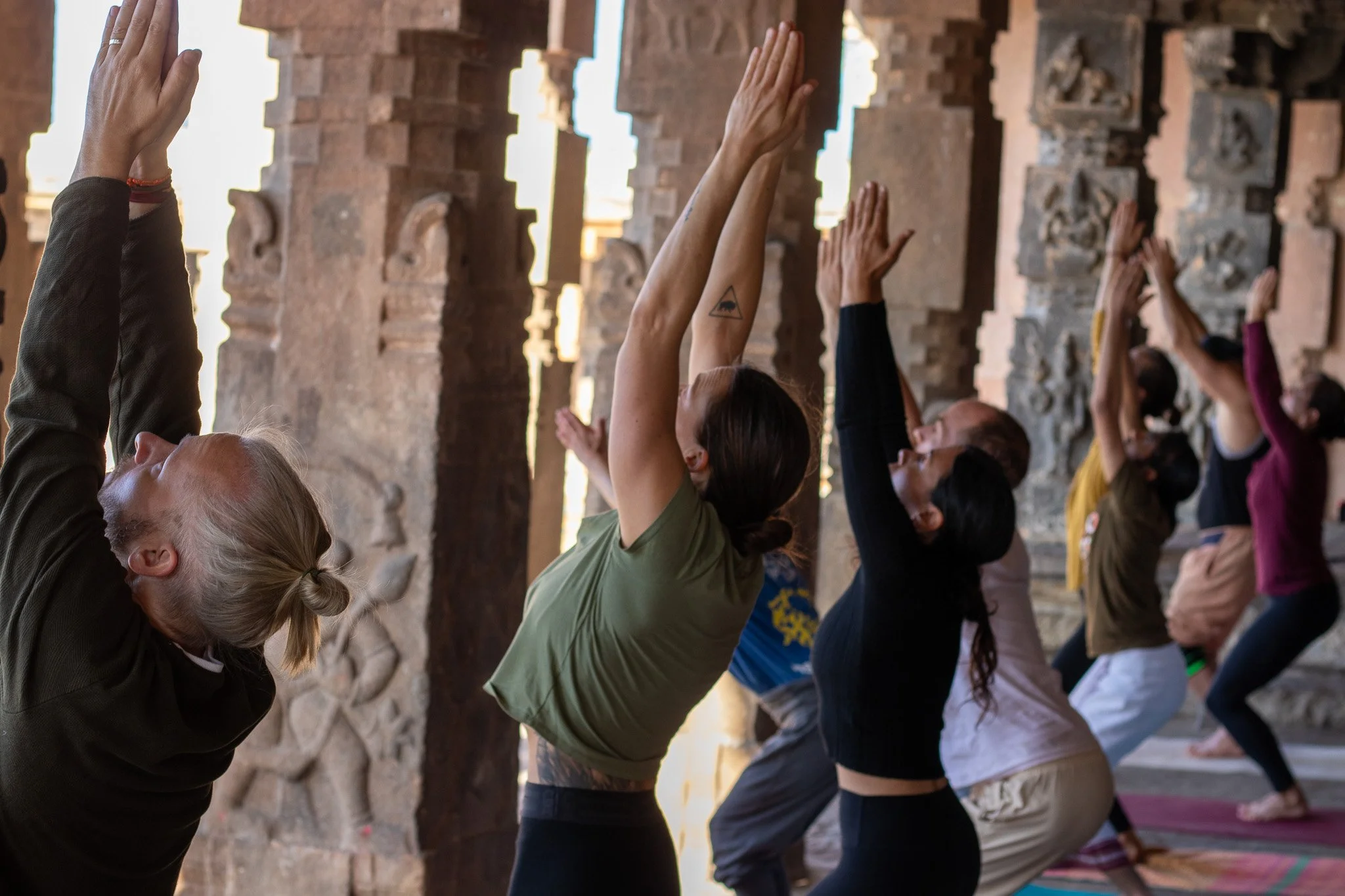
Even the word vinyāsa, in the way we use it in modern postural yoga, does not appear in the classical Sanskrit yoga texts. Sūrya-namaskāra, however, is commonly linked to much older traditions of sūrya-upāsanā (sun worship) and Vedic namaskāra (prostration) rites. The modern, widely recognised sequence and its name were popularised much more recently, but it clearly draws upon older ritual and devotional elements.
Because Aṣṭāṅga Yoga is essentially āsanas strung together with vinyāsa, and because vinyāsa is, in a manner of speaking, drawn from the logic of Sūrya-namaskāra, we can still say that it participates in something ancient. This is very much how Indian thought often works: if a thing has evolved out of an ancient tradition, and it meaningfully contains elements of that tradition, then it is understood as a continuation of that tradition—and therefore it becomes ancient and authentic in spirit, even if the specific form is new.
Aṣṭāṅga Yoga was presented to early Western students in this way.
When we see yoga purely as physical culture, we tend to trace physical practices and quickly discover a simple reality: no one knows exactly how old postural practice is. Some excellent scholarship has been done, and it continues to develop—but the academic world can be contentious, and dates and conclusions shift as new evidence is weighed. What we can say is this: whatever the current estimates are, āsana practice is at least that old, and may prove older as further research continues.
If, on the other hand, we see yoga as a spiritual discipline, then we should look into the spiritual lineage of Śrī Kṛṣṇamācārya, who is often described as a major architect of modern yoga. This is not difficult to approach, because there is a clear and well-documented living tradition there. Kṛṣṇamācārya was an Iyengar, and he stood within a Śrī Vaiṣṇava world shaped by Viśiṣṭādvaita and the teachings of Rāmānuja. There are many texts, ācāryas, historical events, and a coherent philosophy to study.
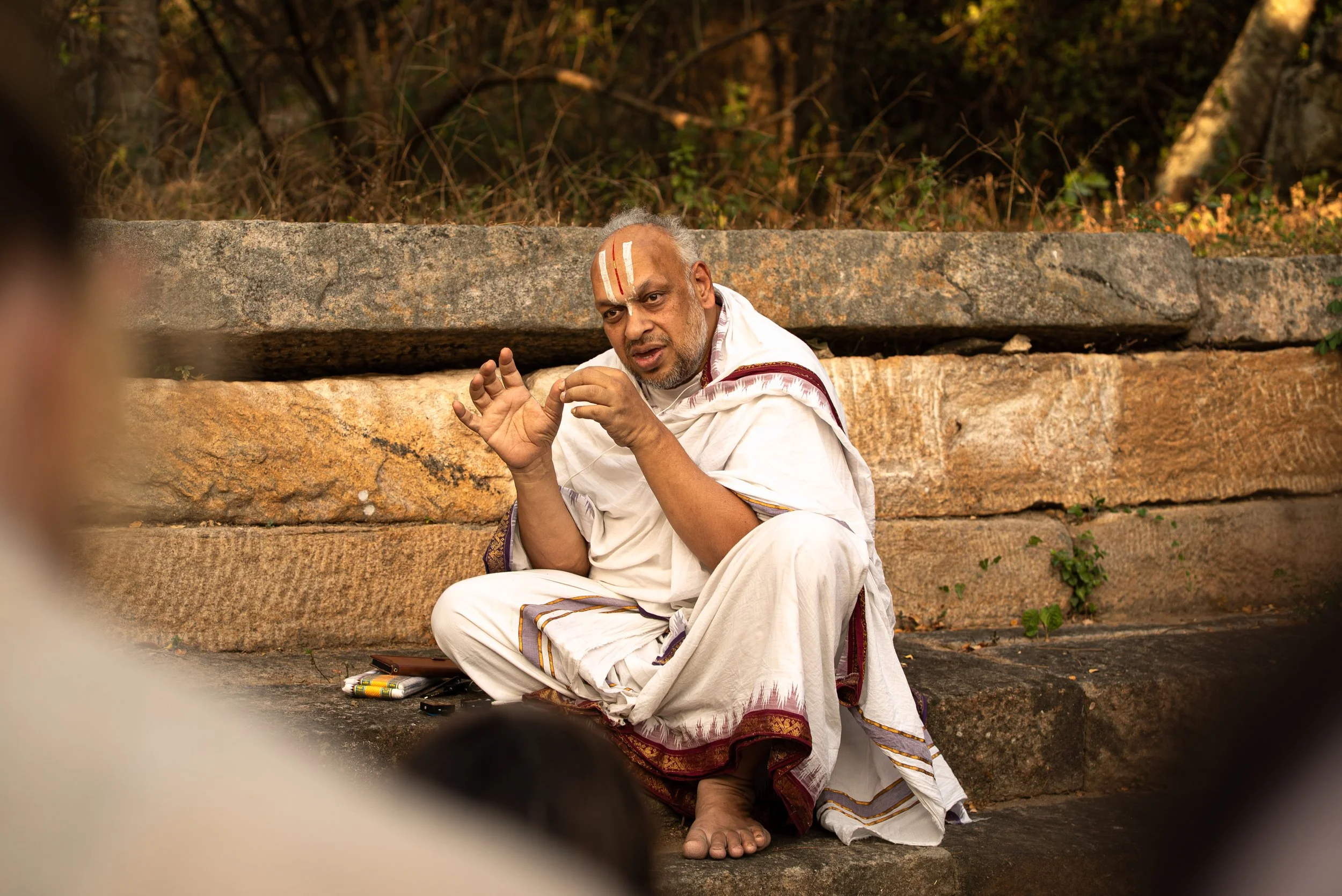
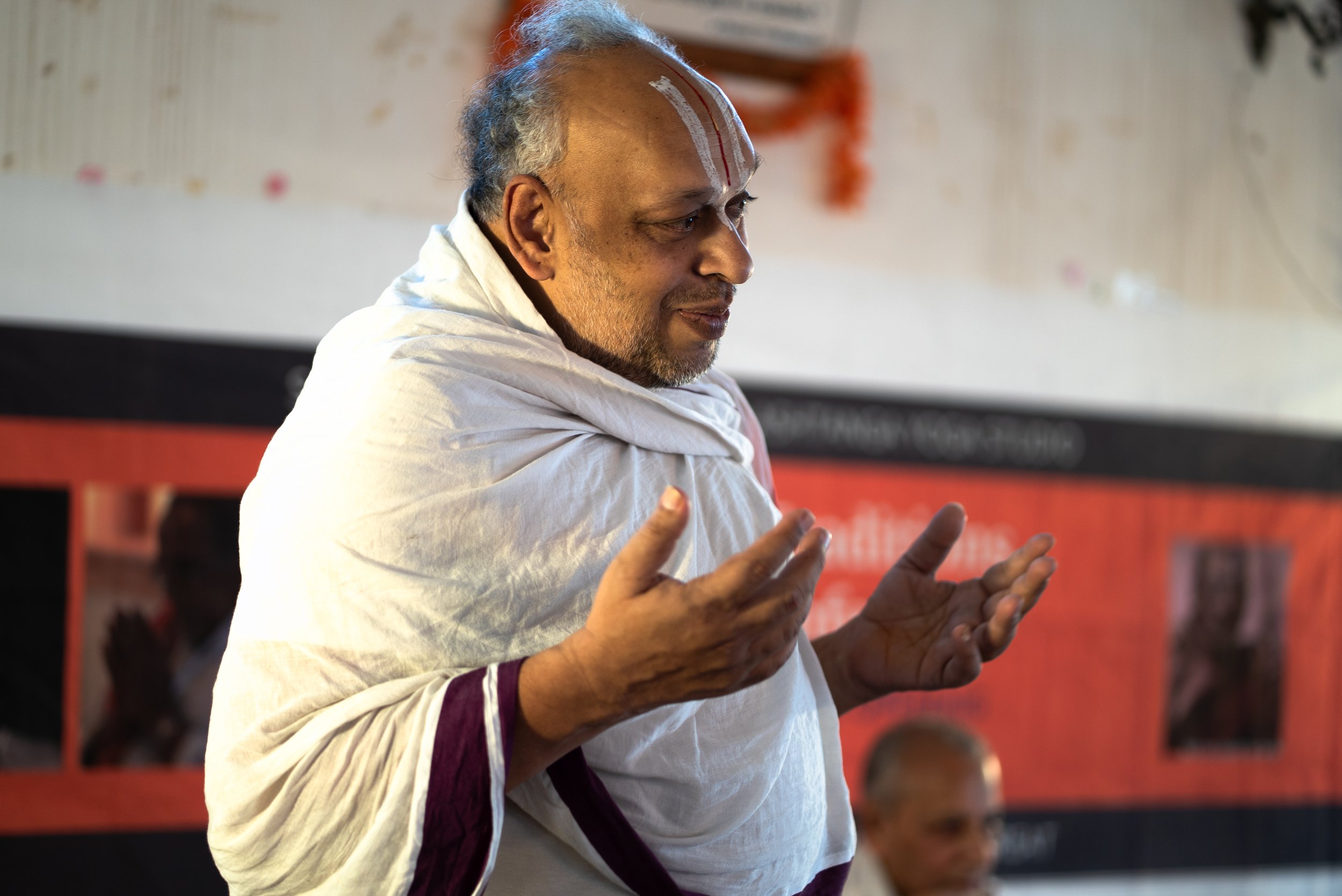
Śrī Alwar is an ācārya in this tradition, which is often referred to as the Nāthamuni Sampradāya. It is a living stream of transmission, handed down through generations. What you will hear in the talk that follows is history, lore, and a vision of life preserved and refined through that paramparā. In the link below you will find more information about the yogic tradition to which Śrī Alwar and his father belong—and which you, too, touch indirectly by studying with them.
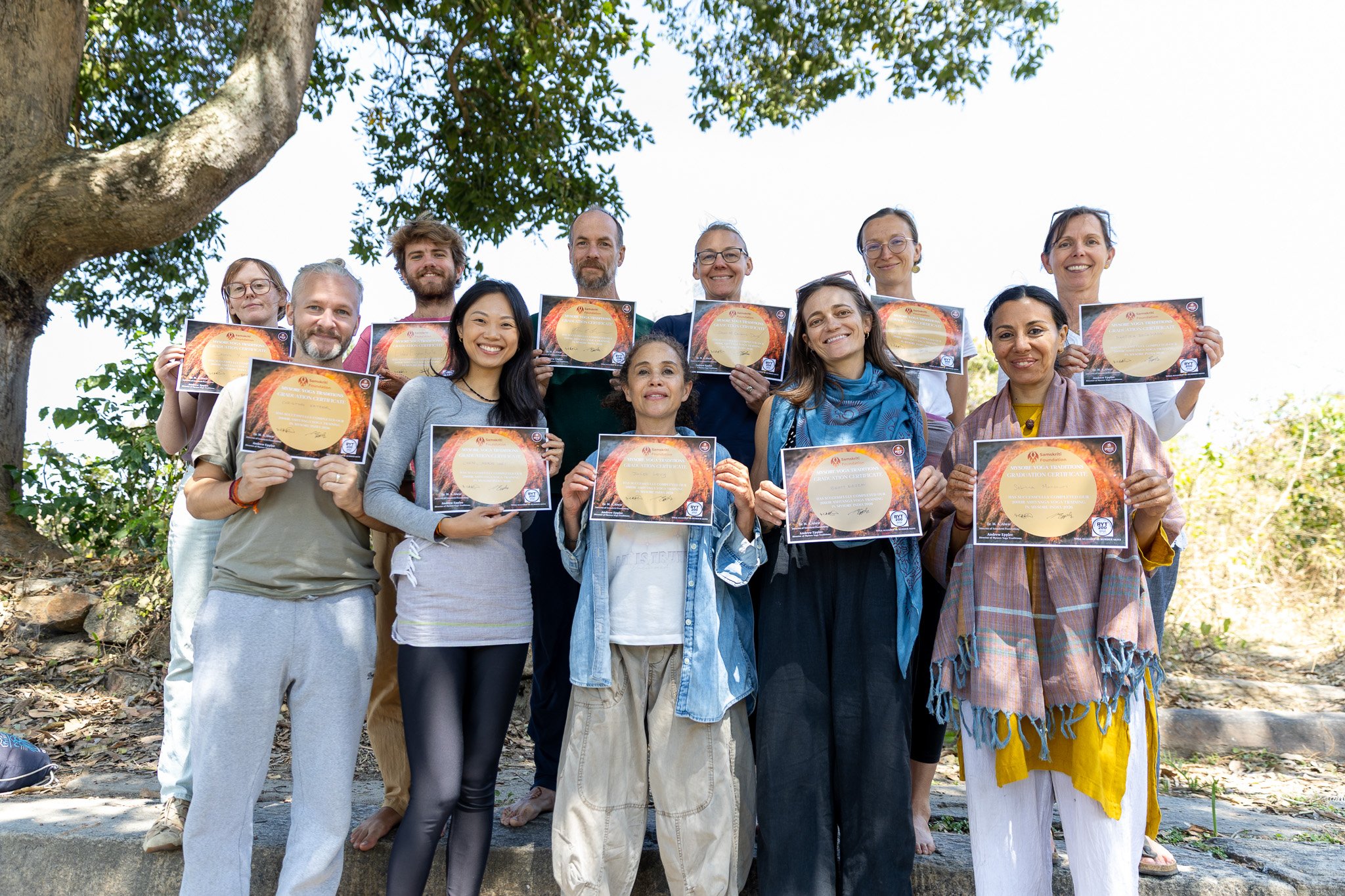
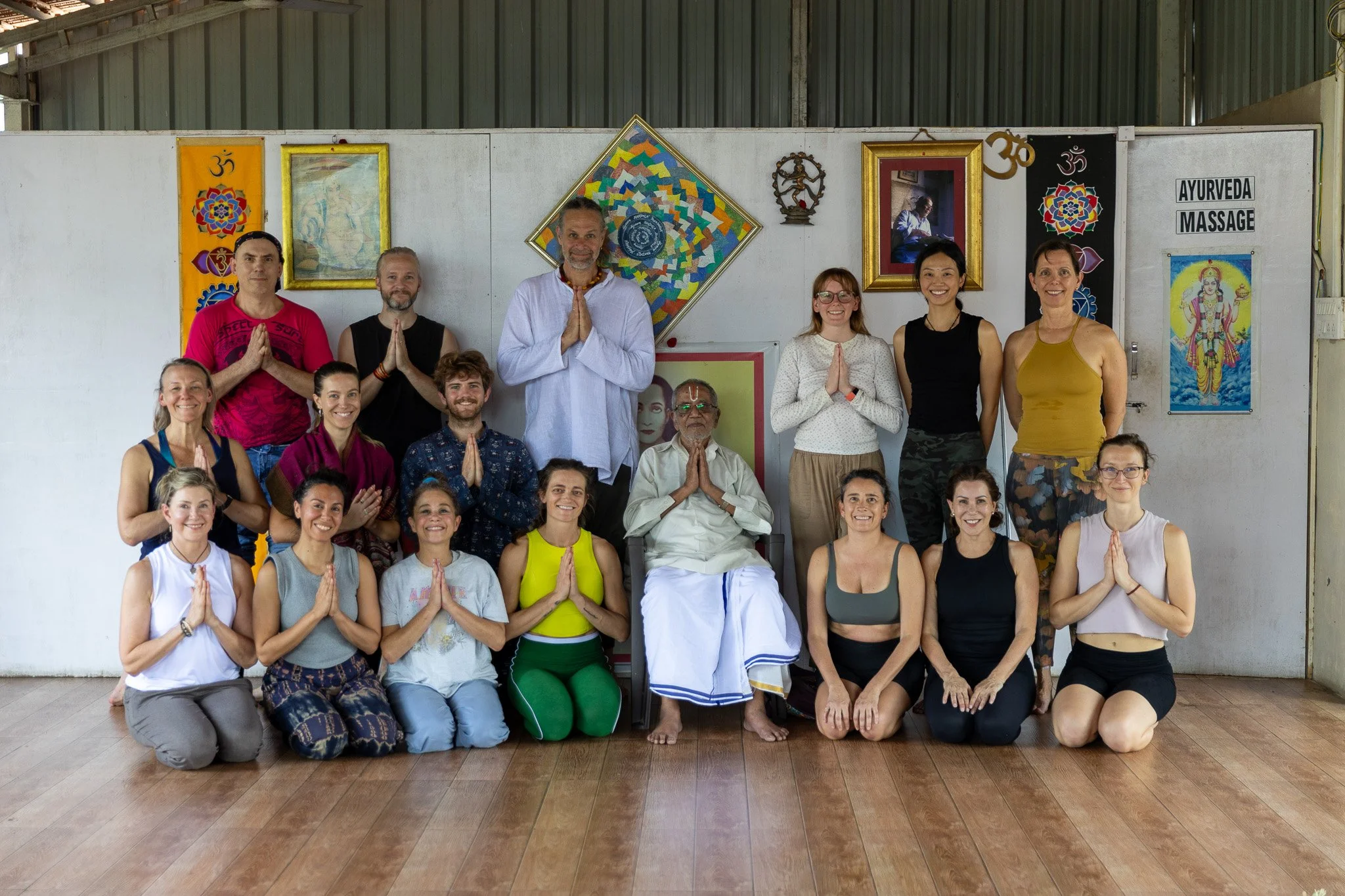
So, without further explanation, please enjoy the teachings of Śrī Alwar, which formed the final section of our 200-hour Aṣṭāṅga Yoga Immersion. If anyone is curious about what this yoga tradition is truly about—its vision of life, its worldview, and its deeper foundations—these talks will be deeply insightful.
In this first talk, Śrī Alwar addresses fundamental questions such as “How do we know that God exists?” His approach is grounded in logic and does not rely on faith-based assertions. This talk is especially useful for understanding Indian religious thought and the foundations of bhakti-based spirituality. The Nāthamuni Sampradāya is a bhakti tradition that unequivocally accepts the existence of God.
Veda Puṣkariṇī is a very significant place in the history of Rāmānuja. Śrī Alwar spoke about this history, and also told the story of Kulaśekhara Āḻvār. There are twelve Āḻvārs in the Nāthamuni sampradāya tradition. (Āḻvār means a saint—one who is totally immersed in the experience of God.) Many ācāryas, down through the centuries, have “Alwar/Āḻvār” as part of their name.
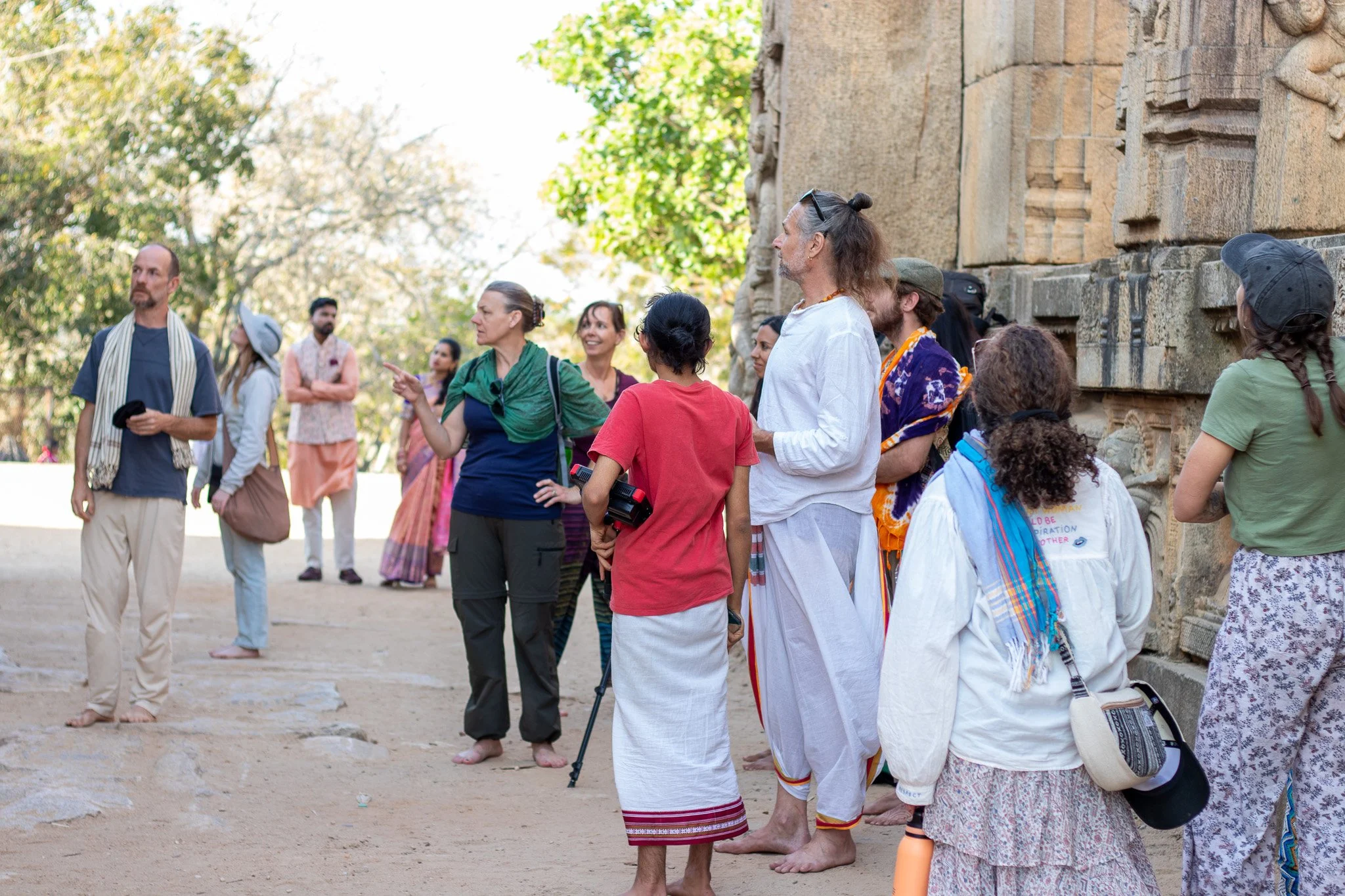
This was a particularly beautiful talk, even though the lighting was very difficult from a video perspective. We had just visited the Cheluva Nārāyaṇa Temple and received a full tour, with detailed explanations of the various shrines and the history. Śrī Alwar then spoke about how the mūrtis of God are understood within his tradition.
The Cheluva Nārāyaṇa Temple is the main temple in Melkote and has enormous historical and symbolic significance. Rāmānuja, the founder of the Viśiṣṭādvaita school of philosophy, is said to have had a vision and learned that a beautiful deity (“cheluva” simply means “beautiful”) was buried in an anthill. He and his disciples uncovered the mūrti and built a temple around it on that very spot just over a thousand years ago.
In this talk, Śrī Alwar shares stories of the twelve Āḻvārs—saints who form a central part of his tradition. One may roughly compare them to the twelve apostles in the Christian faith. In a way, they were divine madmen: intensely poetic, often humorous, and each unmistakably individual—truly dancing to the beat of their own drum.
These rich stories bring forward some of the core values of the Nāthamuni sampradāya and convey its spirit of vision, joy, and devotion.
We were blessed with a guest speaker at Darbha Tīrtha. Suma Ramesh Babu was visiting and attended the lecture. After speaking with Śrī Alwar for a few minutes, he invited her to address our group, and she shared her intriguing story with us. A senior yoga teacher from Bangalore, she was articulate and captivating as she spoke about her yoga journey.
It is my sincere hope that having access to all these lectures will help you assimilate the teachings we received throughout the entire 200-hour Mysore Yoga Immersion. The process of understanding what yoga truly means is a lifelong journey. As Sri Alwar so poetically puts it, “Knowledge is an ocean. How much of the ocean can we hold in our hands? The more we learn, the more we realize how little we actually know. Humility and learning go hand in hand.”
To conclude our lessons, I will leave you with one more substantial body of material to digest slowly, at your own pace: the Bhagavad Gita course with Sri Alwar. Here you will find the distilled vision of spiritual practice as it has been handed down for more than a thousand years within his tradition. This is not an academic study of the Bhagavad Gita, but rather a spiritual testimony—offered with deep humility and purity of heart. To the extent that we can understand these teachings and incorporate them into our lives, we will indeed move closer to the Mysore Yoga Parampara.
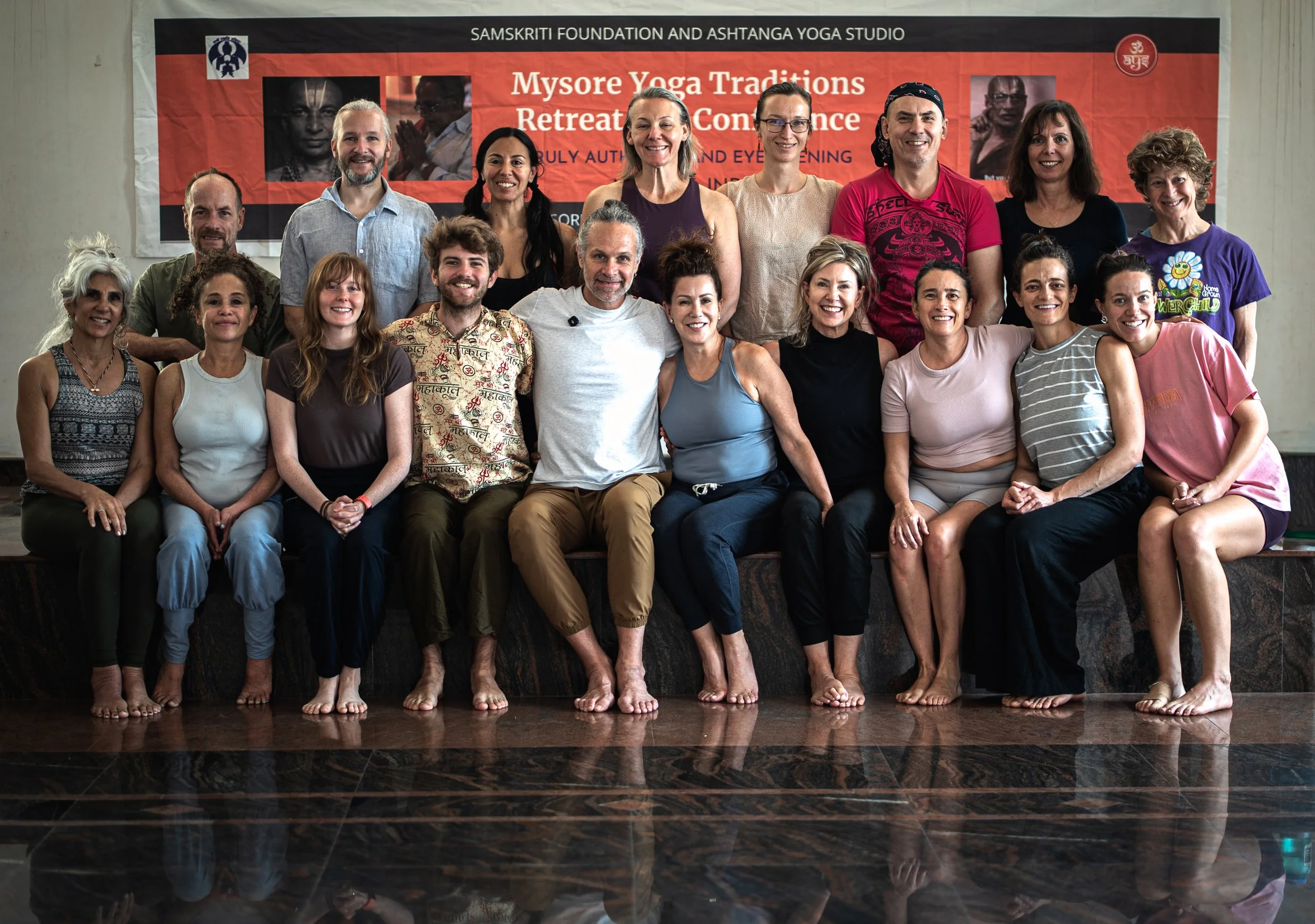
I want to express my sincere gratitude to each of you for joining our immersion, conference, or any part of this training.
https://www.mysoreyogatraditions.com/bhagavad-gita-course
Password: sangraha108
Next year’s dates will be nearly the same at this year, January 12 - February 8 2027. Please join us again if you can!