

Sankhya Karika
Course Introduction
Welcome to the study of Sankhya Karika, one of India's oldest and most influential philosophical systems, attributed to the sage Kapila and systematized by Ishvara Krishna. Sankhya philosophy provides profound insights into the nature of existence, consciousness, and liberation, offering a logical and structured approach to understanding the fundamental realities of life.
Throughout this course, you will explore the essential concepts of Sankhya, including the duality of Prakriti (nature) and Purusha (pure consciousness), the role of the three Gunas (qualities), and the intricate process through which the soul experiences bondage and achieves liberation. You will learn how correct knowledge distinguishes between the ever-changing material world and the unchanging observer consciousness, enabling liberation from suffering and illusion.
Key topics covered in this course will include:
The historical context and foundational principles of Sankhya philosophy.
Understanding the nature of suffering and the strategies proposed by Sankhya to transcend it.
The interplay of Prakriti and Purusha, and how misidentification leads to bondage.
The detailed categorization of human experience, cognition, and perception as laid out in the Sankhya Karika.
Practical implications of Sankhya principles for cultivating detachment, wisdom, and inner freedom.
The concept of the Jivanmukta, the liberated soul who remains engaged in the world out of compassion.
As you delve into the teachings of Sankhya Karika, you will gain valuable tools for intellectual clarity, emotional resilience, and spiritual growth. This course is designed to provide you with the discriminative wisdom necessary to navigate life's complexities with greater peace, purpose, and understanding. Whether you are new to Indian philosophy or seeking to deepen your knowledge, the study of Sankhya Karika promises profound insights into the timeless quest for true freedom.
*the written portion of each lesson is taken from my notes as I listened. Any misspellings or inaccuracies are my fault and no reflection whatsoever on the profound scholarship of Dr. Rao - Andrew
I welcome your feedback and questions! You can contact me at andrew@ashtangayogastudio.com.
Download the Sankhya Karika Text
Lesson 1
The Legacy and Influence of Sankhya Philosophy
Sankhya is one of the oldest philosophical traditions of India, deeply influencing other systems of thought, including Yoga, Vedanta, and Buddhism. At the time of Buddha, Sankhya already existed as a well-established system, though its exact origins remain uncertain. Kapila, the founder of Sankhya, is believed to have lived at least as early as the 6th century BCE. However, his original writings were lost, and the most authoritative work on Sankhya that survives today is the text written by Ishvara Krishna in the 5th century CE, which drew from the now-lost Shashti Tantra.
Sankhya occupies a unique position between theism and atheism. It does not explicitly affirm or deny the existence of God, remaining entirely silent on the matter. Despite this, it profoundly influenced all major Indian philosophical systems, and while no one claims to be strictly a Sankhya follower, its principles form the foundation of many schools of thought. Even the great Advaita philosopher Shankara extensively quotes Sankhya in his works.
The Bhagavad Gita acknowledges the significance of Sankhya, mentioning Kapila directly. The text also emphasizes the close relationship between Sankhya and Yoga, stating that only fools perceive them as separate. While Sankhya is theoretical, focusing on pure or correct knowledge (as its name implies), Yoga is its practical counterpart. Patanjali’s Yoga Sutras fully accept Sankhya, differing only in the acknowledgment of Ishvara (God) as a guiding principle.
One of the core concerns of Sankhya philosophy is suffering (dukha). The first word in its primary text is ‘dukha,’ emphasizing that suffering is an inherent part of life. Every living being experiences suffering, which is categorized into three types:
Internal suffering, such as stomach aches or toothaches, arising from within the body.
External suffering, caused by interactions with others, such as being harmed, insulted, or bitten by an animal.
Unforeseen suffering, which includes natural disasters like floods and earthquakes, as well as supernatural causes like spirit possession, as mentioned in the texts.
Understanding suffering is essential because it allows individuals to seek ways to alleviate it. While various techniques exist to counter suffering, Sankhya argues that none guarantee absolute relief. Despite medical and philosophical solutions, no one can completely escape suffering. Religions and philosophies have long proposed mental attitudes and rituals to transcend suffering, often promising a better life in heaven. However, since heaven is beyond human verification, these promises remain matters of faith rather than certainty.
The concept of purity and impurity also plays a significant role in Indian philosophical traditions. Even Vedic rituals, which aim to purify, involve seemingly impure acts such as animal sacrifice. Sankhya highlights the temporary nature of such rituals, comparing them to a person staying in a luxury hotel—enjoyment lasts only as long as one can afford it. Similarly, the benefits of rituals, tapas (austerities), and even yogic practices are not eternal.
True freedom from suffering, according to Sankhya, requires a transformation of one’s internal state. Even in the most favorable conditions, human emotions like jealousy, sadness, and anger can disrupt happiness. Thus, the key to lasting peace lies in changing one's perception and attitude rather than relying on external circumstances.
A fundamental principle in Sankhya is the distinction between vyakta (the manifest) and avyakta (the unmanifest). What is visible, such as a mountain, consists of invisible elements like atoms. Recognizing both manifest and unmanifest aspects of reality is crucial to understanding and overcoming suffering.
Sankhya's influence extends far beyond its original framework, serving as the philosophical backbone for various Indian traditions. Though it does not claim followers in a strict sense, its insights into suffering, perception, and reality continue to shape spiritual and philosophical thought in India and beyond.
Lesson 2
Sankhya philosophy asserts that suffering is an inherent part of life, and there is no way to completely escape it. While the concept of heaven is mentioned, it is seen as a temporary refuge rather than a permanent solution. Heaven is understood as a place free from suffering, but access to it depends on one's accumulated merit. When this merit runs out, one must leave, just as one would have to vacate a hotel upon depleting their financial resources. This makes heaven an unreliable solution to suffering.
Sankhya, though distinct, may have been influenced by heterodox systems like Buddhism. Vedanta, on the other hand, always adheres to the authority of the Vedas. Sankhya considers three fundamental concepts: the manifest (Vyukta), the unmanifest (Avyukta), and knowledge (Gyana). Vyukta is the ever-changing world that we can perceive, while Avyukta represents what is unseen, such as the roots of a tree. Gyana, or knowledge, is the means by which one attains liberation from suffering. A full understanding of these three leads to liberation according to Sankhya.
Sankhya takes a realist and logical approach, maintaining that the outer world is real. It is a pluralistic system, believing in an infinite number of individual souls, each possessing a unique state. Understanding Vyukta and Avyukta is the first step toward knowledge.
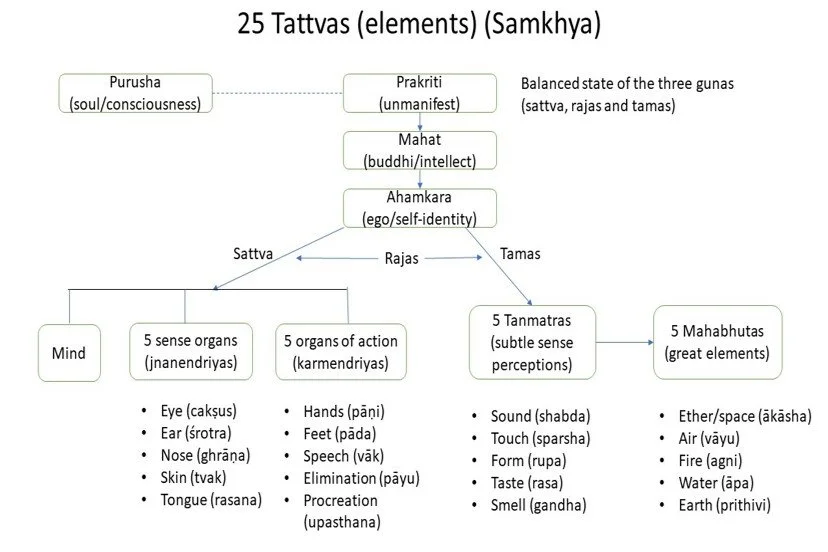
The framework of Sankhya explains how creation unfolds. Mula Prakriti (the primordial nature) gives rise to Mahat (universal intelligence), which then leads to Ahamkara (the sense of individuality). This further differentiates into the five karma indriyas (organs of action), the five gyana indriyas (organs of perception), the five elements, and the mind, which serves both as an organ of perception and action. Finally, there is Purusha, the soul, which neither produces nor originates from anything else.
Sankhya categorizes all aspects of knowledge into four basic categories. Pramana refers to the proof or means of acquiring knowledge, while Prameya is what is understood from the evidence that forms the basis of knowledge. If there is doubt regarding an issue, it means there is no Pramana. Pramana represents correct knowledge, and without conviction in correct knowledge, philosophy cannot exist.
Sankhya recognizes three main Pramanas or valid means of acquiring knowledge:
Direct Perception (Pratyaksha): This involves knowledge acquired through the sense organs. However, this method is limited because it only provides knowledge of the present moment and is constrained by the capabilities of human senses.
Inference (Anumana): Most of our knowledge comes from inference. Animals also use inference to navigate the world. Inference itself can be divided into three types:
From effect to cause: Observing a plant allows us to infer that it must have originated from a seed.
From cause to effect: Seeing dark clouds leads us to infer that it might rain soon.
From observation-based anticipation: When we see one’s spouse, we may infer that their partner is nearby.
Verbal Testimony (Shabda): The spoken word of a reliable and authoritative source is another means of acquiring knowledge. This is widely accepted in philosophical traditions.
Through these three Pramanas, one attains Prameya, or knowledge of reality. However, errors in perception, inference, or reliance on unreliable sources can lead to false conclusions. Despite this, these three means of knowledge are commonly accepted in Sankhya and most other philosophical traditions as essential for acquiring true and correct knowledge.
Sankhya provides a structured and logical way to process and categorize knowledge, emphasizing the importance of direct perception, inference, and reliable testimony. By properly understanding and utilizing these methods, one moves toward knowledge and, ultimately, liberation from suffering.
Lesson 3
Sankhya holds that suffering is inevitable in life. According to this philosophy, the key to liberation lies in understanding the distinction between Vyukta (manifest) and Avyukta (unmanifest), as well as recognizing both what is seen and what is unseen.
Sankhya categorizes all entities into four fundamental groups:
Prakriti – The root cause of all things, not a product of anything itself.
Prakriti-Vikriti – Seven entities that originate from something and also give rise to other things.
Vikriti – Things that only produce other things but are themselves created.
Purusha – The pure consciousness that neither originates from anything nor produces anything.
The Sankhya system recognizes three valid means of acquiring knowledge:
Direct Perception (Pratyaksha) – Knowledge gained through sensory experience.
Inference (Anumana) – Understanding derived from logical reasoning.
Verbal Testimony (Shabda) – Knowledge acquired through trustworthy sources.
These three means of knowledge are widely accepted across various Indian philosophical traditions, though some schools include additional methods.
Prakriti is considered the foundation of all existence. It contains the three Gunas, which cannot be directly seen but must be understood through verbal testimony and inference. From Prakriti emerges Mahat (Buddhi or intelligence), which plays a crucial role in cognition and perception. Since Prakriti and its derivatives are too subtle to be perceived through the senses, their existence is inferred from their effects. This approach formed the basis of ancient philosophical understanding.
Due to the limitations of human perception, we cannot always directly observe reality. Several factors affect our ability to perceive things correctly:
Objects that are too far or too close may not be visible.
Sensory defects, such as color blindness, limit perception.
The mind’s attention is necessary to process sensory input.
Very small or very large objects require instruments to be observed.
Bright light, like the sun, can obscure other objects, such as the moon or planets.
An object can be indistinguishable among many similar objects.
Since many things exist beyond direct sensory perception, inference and verbal testimony become crucial in understanding reality. The existence of Prakriti, Mahat, Ahamkara (individual ego), and Tanmatras (subtle elements) must be inferred from their effects rather than seen directly.
Sankhya philosophy explains the cause-and-effect relationship using practical examples. A pot is made from clay, and though its shape changes, its essence remains clay. Similarly, gold remains gold whether in a lump or a necklace. This demonstrates that the material cause inherently contains its effects in subtle form.
Different philosophical traditions in India debate the nature of causality. Some schools argue that causes arise spontaneously, while Sankhya maintains that all effects are already present in their material causes. This is illustrated by the idea that a sculpture’s form is already present within the rock before it is carved.
Based on this logic, Sankhya asserts that nothing is truly created or destroyed. Something that does not exist cannot come into existence, and something that exists cannot be annihilated—only its form can change. This principle serves as the foundation of Sankhya thought and aligns with observable reality.
By examining the manifest world (Vyukta), we can gain insight into the unmanifest (Avyukta). Manifest forms are temporary—mountains erode, buildings crumble, and all living beings age and perish. Time is relentless in its destruction of all that is visible. However, the underlying principles of nature remain unchanged. Vyukta is impermanent, while Avyukta is eternal.
Prakriti, which is Avyukta, is ever-present and unchanging. It serves as the fundamental reality that underlies all transformation in the universe. By understanding this, Sankhya offers a pathway to transcend suffering and achieve liberation.
Lesson 4
Sankhya philosophy acknowledges that suffering is inherent in life. While remedies exist, they are uncertain, and scriptures that speak of a heaven free from suffering are also unreliable according to Sankhya. The only way to avoid suffering is through the understanding of the manifest (Vyukta), the unmanifest (Avyukta), and the true nature of the self (Purusha).
Sankhya is based on twenty-four fundamental principles, categorized into three groups. The means of knowledge are threefold: direct perception, inference, and verbal testimony from a truthful person. Even though certain principles such as Prakriti, Purusha, and Mahat cannot be directly perceived, they can be inferred and are consistently described by great sages. Their presence is real, though subtle.
Sankhya asserts that all things exist in their material cause. Just as a pot exists in clay, cloth exists in cotton, and jewelry exists in gold in their potential forms, nothing is truly created or destroyed—everything is merely transformed. Prakriti is the fundamental source, always present and unchanging. The Gunas are inherent in Prakriti but do not exist in Purusha.
Purusha is distinct from intelligence (Buddhi). It is the observer, similar to how a telescope cannot see itself but is used by an intelligent person to view distant objects. The Gunas—Satva, Rajas, and Tamas—are the fundamental forces of nature.
Satva is characterized by happiness, joy, and clarity. It is the force behind artistic expression, poetry, and intellect. Rajas is the force of passion, activity, and sometimes violence. It is the driving energy of motion and change. Tamas represents inertia, stability, and passivity. It is heavy, dark, and obscuring.
These Gunas interact dynamically. When one is dominant, the others are suppressed, yet they work together to create the world as we experience it. This interplay is likened to an oil lamp, where oil, wick, and fire must be balanced for the flame to burn properly. Similarly, these forces must be in proportion for the natural world to function harmoniously.
The principle that the effect always reflects the qualities of its cause is central to Sankhya. Just as food reflects the ingredients used to prepare it, everything in the world carries the inherent properties of the Gunas. Plants derive their flavors from the earth, much like human dispositions are influenced by the Gunas present in their constitution.
Happiness, unhappiness, and neutrality correspond to Satva, Rajas, and Tamas, respectively. These forces operate as positive, negative, and neutral energies that pervade all of existence. Anything that is produced cannot be all-pervasive—only subtle principles can be. Prakriti, though unseen, is the underlying cause of everything. Like water from different wells tasting different despite originating from the same rain, the variations in nature arise from different combinations of the Gunas.
The concept of the soul is a central debate in Indian philosophy. Materialist schools such as Charvaka argue that the self is merely the brain and body. Certain Buddhist schools propose that the soul is a sequence of passing sensations that transmigrate between bodies. Other traditions believe in a permanent soul governed by God.
Sankhya holds that Purusha is distinct from Prakriti, permanent, and free from change and suffering. According to Sankhya, suffering arises from the confusion between Purusha and Prakriti. Liberation is achieved when one realizes this distinction and identifies with Purusha, thus attaining freedom from suffering.
Lesson 5
The Concept of Purusha in Sankhya Philosophy
In Sankhya philosophy, the most important principle is Purusha, the soul. The existence of Purusha is considered certain and has been proven in previous discussions. All of creation evolves out of Purusha, but the soul itself remains untouched by the material world. Unlike other elements of existence, Purusha does not come from anything and does not produce anything. It is eternal, independent, and infinite.
Sankhya philosophy asserts that there are an infinite number of souls. This is evident in the fact that people are born and die at different times, and each individual possesses unique qualities and characteristics. These variations further support the concept of individual souls, each with its own purpose and journey.
Despite being the source of all experience, Purusha is merely a witness to the changes in Prakriti, the material world. It does not actively participate in these transformations. However, due to the interplay between Prakriti and Purusha, humans mistakenly identify themselves with the material world. This leads to both suffering and enjoyment, which are illusions created by this interaction.
An analogy used in Sankhya philosophy illustrates this concept: when a blue flower is placed in front of a crystal, the crystal appears blue, even though it has no color of its own. Similarly, our intellect reflects in Purusha, creating the illusion that the soul is affected by worldly experiences. However, just as the crystal remains colorless, the soul remains unchanged by the material world.
The goal of Sankhya philosophy is to remove this illusion. Liberation, or kaivalya, is not about transforming the soul into something different but about realizing its true nature. This understanding separates the soul from the material world in one's consciousness, freeing it from suffering.
A metaphor often used to describe the relationship between Prakriti and Purusha is that of a blind man and a lame man. The blind man can walk but cannot see, while the lame man can see but cannot walk. By carrying the lame man on his shoulders, the blind man gains direction, and together they can function. In the same way, Purusha provides awareness, while Prakriti provides activity. Without each other, they cannot create the experience of life. However, when Purusha realizes its distinction from Prakriti, it is freed—like a bird escaping from a net and flying into the sky.
Sankhya describes the structure of existence through the evolution of 16 aspects from Ahamkara (the sense of self). These include the five senses, the five actions of the senses, the five elements, and the mind. These elements create the world we perceive, and their interactions are governed by the Gunas—Satva (purity and knowledge), Rajas (movement and passion), and Tamas (inertia and ignorance).
Buddhi, or intelligence, is considered the purest form of Satva. In contrast, the external world is dominated by Tamas, while Rajas facilitates movement between them. The mind, or Manas, functions as both a sensory organ and an organ of action. It is through the mind that sensory perception becomes meaningful—without attention, even if the senses are functioning, no information is registered.
In this structured worldview, Sankhya presents a detailed order of creation. It seeks to explain the nature of existence and the process of liberation. By understanding the true nature of Purusha, one can break free from the illusion of suffering and achieve ultimate freedom.
Lesson 6
The Functioning of Mind, Intellect, and Sense of Self in Sankhya Philosophy
Sankhya philosophy presents a detailed understanding of human perception and action, emphasizing the distinct yet interconnected roles of the mind (manas), intellect (buddhi), and sense of self (ahamkara). These three internal faculties, known as the trikaranas, work together to interpret sensory information, guide decision-making, and shape individual identity. Unlike the external sense organs, which passively receive information, the internal faculties actively process and respond to stimuli, making them the true drivers of perception and action.
According to Sankhya, the mind serves a dual function: it is both a sense organ and an organ of action. Each of the five sense organs—eyes, ears, nose, tongue, and skin—has a specific function, but they do not act upon the objects they perceive. Instead, they transmit impressions to the mind, which then sends these impressions to the intellect for processing. The senses (gyan indriyas) only observe, while the organs of action (karma indriyas) enable movement and response. For clarity, Sankhya distinguishes between these functions, ensuring that their roles are properly understood.
The Role of the Trikaranas
The three internal faculties each have a specific purpose:
Manas (Mind) observes the world through the senses.
Ahamkara (Sense of Self) creates personal identification with experiences.
Buddhi (Intellect) makes decisions and determines appropriate responses.
These faculties function like different workers in an office, each performing its designated role but working together as a system. For any action to take place, these aspects must function in unison. Even in the smallest fraction of a second, they operate seamlessly to produce thought, perception, and response.
The Energy System: The Five Pranas
Sankhya also describes an energy system that sustains bodily functions through five vital forces, known as prana vayu:
Prana vayu governs the heart and respiration.
Apana vayu is responsible for the elimination of waste.
Udana vayu operates in the throat, supporting speech and sensory functions.
Samana vayu controls digestion at the navel center.
Vyana vayu pervades the entire body, ensuring circulation and coordination.
These pranas are driven into action by the mind, intellect, and sense of self. Every function of the body—movement, perception, digestion, and speech—arises from the coordinated effort of the trikaranas and the pranas.
The Nature of Perception
A significant debate in Indian philosophy concerns the mind's ability to engage with multiple senses at once. The Nyaya school argues that the mind can only connect with one sense organ at a time, rapidly shifting between them. Sankhya, however, maintains that the senses work in unison, and the mind is so fast that this process appears seamless.
Regardless of this distinction, all perception involves the coordinated effort of buddhi, manas, and ahamkara. Importantly, Sankhya holds that all these functions arise internally, without the need for divine intervention. When a person gets a cut, the body naturally begins healing itself—not because of a higher power but due to the inherent intelligence of the body's energy system. This view aligns with Sankhya’s rejection of a creator god, emphasizing an internal, self-sustaining order.
The 13 Karanas: The Complete System of Action
Every action involves 13 faculties, collectively referred to as the karanas:
The five sense organs (eyes, ears, nose, tongue, skin)
The five organs of action (speech, hands, feet, excretion, reproduction)
The three trikaranas (buddhi, manas, ahamkara)
Whenever we perceive an object, these 13 faculties work together to illuminate it, analyze it, and form an understanding of its nature. The external senses provide raw data, but the internal trikaranas interpret this information, enabling reasoning, inference, and anticipation of the future.
The Importance of Internal Awareness
Sankhya philosophy teaches that while the senses function in the present moment, they lack intelligence. The ear can hear sounds, and the eye can see forms, but without the intellect, they cannot process meaning. The internal faculties are therefore more crucial than the senses themselves. For example, a brain-dead person may have perfectly functioning eyes and ears, yet without buddhi, manas, and ahamkara, they remain incapable of perception.
A well-known analogy illustrates this point: just as oil, a wick, and fire must work together to produce light, the trikaranas must operate in unison to create knowledge and awareness. They serve as a bridge between the individual and the external world, shaping our experience of reality.
From External Perception to Inner Realization
While the trikaranas help us navigate the material world, Sankhya philosophy ultimately aims to direct awareness inward, away from external distractions, toward the perception of Purusha, the eternal soul. By understanding the distinction between the material world and the inner self, one can transcend worldly entanglements and achieve liberation.
Sankhya thus provides both a detailed system for understanding human perception and a pathway to self-realization. It teaches that our awareness can either be drawn outward, leading to suffering and attachment, or directed inward, leading to freedom and enlightenment.
Lesson 7
The Role of Buddhi in Liberation: Understanding Sankhya Philosophy
Sankhya philosophy is deeply concerned with liberation from the suffering of life. It presents a dualistic framework in which Prakriti (the material world) and Purusha (the eternal self) are distinct. The key to achieving liberation lies in understanding this difference. However, the very mechanism through which we experience the world—the Buddhi (intellect), along with the mind (Manas) and the senses (Indriyas)—also continuously transmits experiences to the Purusha. This raises a critical question: If Buddhi is always engaged in perceiving and processing experiences, how can liberation be attained?
The Paradox of Buddhi: The Problem and the Solution
Sloka 27 of the Sankhya teachings states that while Buddhi continuously delivers experiences to the Purusha, it also holds the power to grant liberation. The root of our problem is also its cure. Most people mistake Buddhi for Purusha, believing that their intellect and sense of self are their true essence. However, Buddhi is a product of Prakriti, not Purusha. This fundamental misunderstanding binds individuals to the cycle of suffering. True liberation comes when one trains the Buddhi to distinguish between material experience and the soul principle.
Training the Buddhi: Perceiving the Subtle Reality
Our experience of the world is mediated by the senses, which only perceive material objects. In Sanskrit, such perceivable things are called Vishesha. However, there is another category of existence, Avishesha, which refers to the subtle, imperceptible aspects of reality. The intellect (Buddhi), the sense of self (Ahamkara), and the mind (Manas) belong to this subtle category. They form part of the subtle body, which cannot be seen or directly experienced through the senses but plays a crucial role in shaping our existence.
Every individual possesses two bodies: a physical body, which is temporary, and a subtle body, which is enduring. The physical body is composed of the five elements and is inherited from our parents. In contrast, the subtle body is unique to each person and continues beyond the death of the physical form. According to Sankhya, this subtle body carries impressions, tendencies, and karma across lifetimes, much like a cloth bag retains the fragrance of flowers it once carried.
The Relationship Between Prakriti and Purusha
Sankhya teaches that Prakriti provides the material conditions for experience, while Purusha is the conscious principle that undergoes these experiences. Just as an artist needs a canvas to manifest their vision, the subtle body requires the physical body to interact with the world. Similarly, an actor may change roles in a drama, yet their underlying identity remains unchanged. This illustrates how the subtle body transitions through different incarnations, while Purusha remains the unchanging witness.
Certain aspects of our being are innate—we are born with particular talents, dispositions, and tendencies. Others are acquired through experience and learning. For example, the ability to hear is natural, but speaking requires practice. The combination of inborn traits and learned characteristics gradually shapes an individual’s identity, both internally and externally.
The Path to Liberation: Differentiating Between the Subtle and Material Bodies
Liberation in Sankhya philosophy comes from recognizing the distinction between the subtle body and the material body. By training the Buddhi to perceive this difference, one begins the journey toward freedom from suffering. This process is guided by Dharma, the principle that governs spiritual evolution. Acting against Dharma leads to ignorance and the degradation of consciousness, whereas aligning with it elevates the individual.
The ultimate goal of Sankhya is to attain correct knowledge—to understand what is temporary (Prakriti) and what is permanent (Purusha). The Buddhi, which initially binds us to the world by processing sensory experiences, also has the power to set us free. Through proper discernment, one can transcend material attachments and realize the eternal nature of the self. Thus, Sankhya presents Buddhi not only as a conveyor of worldly experiences but also as the key to liberation.
Lesson 8
Liberation Through Correct Knowledge: A Sankhya Perspective
Sankhya philosophy asserts that correct knowledge of life, Prakriti (nature), and Purusha (the soul) is the key to liberation, while ignorance binds individuals to suffering. Those who remain entirely absorbed in the material world become entrapped in its illusions, unable to perceive their true nature. Detachment (Varsha) is essential for breaking free from this bondage, allowing one to transcend material limitations and experience true freedom.
At the core of human experience is the Buddhi (intellect), which plays a crucial role in shaping perception and understanding. There are four classifications of Buddhi: incorrect knowledge, inability, contentment, and the acquisition of supernatural powers. The constant interplay of the Gunas—Sattva (purity), Rajas (activity), and Tamas (inertia)—determines which aspect of Buddhi dominates at any given time, influencing an individual’s state of being.
The Five Types of Ignorance (Kleshas)
Ignorance manifests in five primary forms, known as Kleshas, which contribute to human suffering:
Avidya – Misunderstanding or erroneous knowledge, which leads to incorrect perceptions of reality. This is associated with the Tamas Guna (darkness and ignorance).
Asmita – Misidentification of the self with the body, mind, and material world. This attachment creates a false sense of identity and disconnects one from the eternal Purusha.
Raga – Strong attachments to material possessions, status, or sensory pleasures, which bind individuals to desires and suffering.
Dvesha – Aversion or hatred toward things that are unattainable or undesirable, further reinforcing emotional turmoil.
Abhinivesha – The deep-seated fear of death and clinging to life, resisting the impermanence of the physical world.
Inability (Ashakti) and Its Role in Human Limitation
In Sankhya, inability or Ashakti arises when there is a weakness or dysfunction in the instruments of perception and action, such as the senses and mind. There are 33 types of Ashakti, each representing different forms of limitations that hinder progress. These limitations prevent individuals from perceiving reality clearly and functioning optimally.
The classification of all these aspects—ignorance, inabilities, and different types of Buddhi—helps in understanding the root causes of suffering. By identifying these sources, individuals can work towards overcoming them and progressing toward liberation.
The Mistaken Identification with Prakriti
A fundamental misunderstanding in human experience is the tendency to identify the Purusha (the true self) with Prakriti (the material world). This identification creates attachment, suffering, and cycles of rebirth. Those who grasp the principles of Prakriti and Purusha gain extraordinary insight and abilities. However, even these supernatural abilities (Siddhis) can become a trap, fostering fear of loss and a distraction from ultimate liberation.
The Dual Nature of Contentment
Contentment (Santosha) is a quality that can be both beneficial and detrimental. A Yogi must cultivate contentment to attain inner peace and detachment. However, contentment can also lead to complacency and stagnation when it results in apathy or resistance to further learning and self-improvement.
The belief that nature (Prakriti) alone governs all outcomes is a misconception in Sankhya. While natural processes dictate material existence, one must take active responsibility for personal growth and understanding. Similarly, the notion that time alone will resolve all issues is flawed—time is available to everyone, but conscious effort is necessary to bring about meaningful change.
Overcoming Illusions and Attaining True Knowledge
Some believe that luck determines fate, which reflects a lack of intellectual comprehension of reality. While chance may play a role, true understanding comes from deep reasoning and study. Those content with superficial knowledge hinder their own progress and remain trapped in illusion.
Sankhya teaches that the interplay of Prakriti and Purusha creates all aspects of existence. The greatest philosophical question remains: How can a compassionate God allow suffering? Sankhya deeply explores such fundamental questions, offering insights into the origins of existence and the path to liberation.
Ultimately, Sankhya philosophy provides a framework for transcending ignorance through knowledge. By recognizing the distinction between the eternal Purusha and the ever-changing Prakriti, one can move beyond suffering and attain true freedom. Through disciplined study, introspection, and the guidance of wise companions, individuals can refine their understanding and walk the path of self-realization.
Lesson 9
The Interplay of Prakriti and Purusha: Understanding Sankhya Philosophy
Sankhya philosophy provides a profound framework for understanding human cognition, perception, and the relationship between Prakriti (nature) and Purusha (the experiencer or soul). Lesson 9 of the Sankhya Karika outlines key divisions of thought, categories of misconception, suffering, and the role of knowledge in attaining liberation. By categorizing all facets of human understanding, Sankhya aims to offer a systematic approach to self-realization and emancipation.
The Four Divisions of Thought
Sankhya philosophy classifies human thought into four main divisions, further divided into 50 subcategories. This classification helps in comprehending the complexities of cognition and perception, aiding in the differentiation between knowledge and ignorance. The text attempts to categorize all facets of human cognition and perceptions, emphasizing the importance of structured understanding.
Misconception, Delusion, and Wrong Contentment
Misconception in Sankhya is divided into eight types, while delusion is classified into ten types. Additionally, there are nine kinds of wrong contentment that hinder intellectual and spiritual growth. Some of the most dangerous misconceptions include the belief that nature takes care of everything, the idea that time dictates all outcomes, and the notion that luck is the ultimate controller of destiny. These incorrect perceptions lead individuals to complacency and inaction, preventing them from actively seeking knowledge and self-improvement.
Many practices are also considered misguided paths to self-realization. These include avoiding all negative experiences, adhering to special diets delivered to one's door, and abstaining entirely from sensory pleasures. While they may appear beneficial, they do not address the root causes of ignorance and suffering. Another potential hindrance is the pursuit of Siddhis (supernatural powers), which, rather than aiding in liberation, can become distractions that bind one further to the material world.
The Importance of Reason and Study
For a student of Sankhya, the ability to reason is indispensable. Good teaching and self-study form the foundation of acquiring correct knowledge. Without logical analysis and deep contemplation, one cannot truly grasp the principles of Sankhya. As in the relationship between a teacher and student, Prakriti and Purusha are mutually dependent—one cannot exist without the other.
The Three Types of Suffering
Sankhya categorizes suffering into three primary types:
Internal suffering – Arises from ailments within the body, such as pain, stomach aches, or toothaches.
External suffering – Comes from disturbances in the environment, such as noise, chaos, or social conflicts.
Suffering from unknown causes – Includes natural disasters like earthquakes or floods.
All suffering falls within these three categories, and any of them can act as impediments to one's spiritual path.
The Eight Methods of Obtaining Correct Knowledge
Overcoming ignorance, disability, and contentment requires actively seeking knowledge. Sankhya outlines eight different ways to obtain correct knowledge, emphasizing the necessity of intellectual rigor and self-inquiry. By abandoning ignorance and complacency, individuals can progress toward liberation.
Categorization in Sankhya Philosophy
Sankhya attempts to categorize all aspects of existence, including living creatures, the elements of creation, and even divine principles. The highest entity in this hierarchy is Brahma, while the lowest is a simple blade of grass. Heaven and hell are viewed as conceptual states rather than provable realities; instead, they are metaphorically represented by the Gunas—Sattva as heaven, Rajas as the earthly plane, and Tamas as hell.
The Duality of the Physical and Subtle Body
Every human being possesses two bodies: the physical body, inherited from one's parents, and the subtle body, which is eternal. The Sanskrit term for the subtle body is "Oksana Sarria," and it is believed to transcend individual lifetimes, carrying samskaras (impressions) from one incarnation to the next. This ongoing cycle of birth and rebirth is orchestrated by Prakriti, which serves as the stage upon which the soul learns and evolves.
The Purpose of Prakriti and the Path to Liberation
The purpose of Prakriti is to facilitate the evolution of every soul. Every individual has the right to learn about their true nature and attain self-realization. Sankhya philosophy describes life as a "free show"—no one buys a ticket, yet every soul participates in the grand experience of existence. When a soul attains full realization, it achieves kaivalya (liberation) or samadhi.
Prakriti, in its sentience, assists Purusha in reaching liberation. This relationship is analogous to milk being produced for the nourishment of a calf—Prakriti exists to guide the soul to emancipation. However, in modern times, humanity has largely abandoned nature rather than working in harmony with it.
The Distinction Between Prakriti and Purusha
A crucial aspect of Sankhya is the understanding that Prakriti and Purusha are fundamentally different. Prakriti operates through the three Gunas—Sattva, Rajas, and Tamas—while Purusha is beyond all qualities. This realization is key to breaking free from the cycle of suffering and attaining liberation.
In conclusion, Sankhya philosophy provides a structured and detailed approach to understanding human cognition, suffering, and the path to liberation. By categorizing thought, knowledge, and suffering, it offers a clear roadmap for self-inquiry and enlightenment. The interplay between Prakriti and Purusha, when properly understood, leads to the ultimate goal—freedom from the illusions of the material world and realization of one's true nature.
Lesson 10
The Interplay of Prakriti and Purusha in Sankhya Philosophy
Sankhya philosophy offers a profound understanding of the nature of existence by distinguishing between two fundamental principles: Prakriti and Purusha. This dualistic framework not only explains the origin of all experiences but also provides a pathway to liberation. This essay explores the qualities of Prakriti, the formless nature of Purusha, and the means by which true knowledge liberates the soul.
1. Fundamental Concepts: Prakriti and Purusha
Prakriti: The Qualitative Nature
Prakriti is characterized by its inherent qualities (gunas). It is dynamic, ever-changing, and possesses subtle nuances that shape the material world. Sankhya philosophy portrays Prakriti as delicate and feminine. It serves Purusha by presenting the manifold experiences of life without expecting anything in return. Prakriti is compared to a servant who provides all experiences—both suffering and pleasure—yet remains uninvolved with the essence of Purusha.
Purusha: The Qualmless Observer
In stark contrast, Purusha is devoid of any qualities. It is the eternal, unchanging, and observer consciousness. As nirguna—without gunas—it is inherently free and unbound by the fluctuations of the material world. The idea of bondage is seen as an illusion born from the interaction with Prakriti, rather than an inherent characteristic of Purusha. This separation explains why, despite the ever-changing nature of the material world, the true self remains untouched.
2. The Relationship Between Prakriti and Purusha
Mutual Interaction and Illusion of Bondage
Prakriti, with its mutable qualities, interacts with Purusha to create the experience of life. This interaction is asymmetrical: Prakriti serves Purusha by providing experiences, while Purusha, being free and unchangeable, does not reciprocate or get affected by Prakriti’s qualities. The transient changes, including suffering and pleasure, occur solely in Prakriti, leaving Purusha untouched. This fundamental separation is at the core of Sankhya’s insight into the nature of bondage and liberation.
The Illusion of Misidentification
A critical aspect of this philosophy is the misconception that arises when one identifies with Prakriti instead of recognizing the true nature of Purusha. Analogies such as mistaking a rope for a snake illustrate this error. Just as the rope only appears to be a snake—causing fear and distress until recognized for what it truly is—so too does the misidentification of the material world with the self lead to unnecessary suffering. Once true knowledge is attained, the allure of Prakriti diminishes, and one becomes liberated from the cycle of experience.
3. Pathway to Liberation through Knowledge
Gyana and the Discriminative Insight
Sankhya teaches that liberation, or Moksha, comes from discriminative knowledge (Gyāna). Kevala Gyana, or absolute knowledge, enables one to discern between the ever-changing Prakriti and the immutable Purusha. When this knowledge is fully realized, the material allure of Prakriti loses its charm; it becomes “shy” and withdraws from view. In this state, the soul (Atman) understands its true identity as Purusha and is freed from the illusions of suffering and external change.
The Binding Forces and Their Antithesis
The experience of bondage is attributed to various dualities such as Dharma versus Adharma, Vairagya versus Avairagya, and Gyana versus Agyana. These oppositions keep Purusha entangled in the fluctuations of Prakriti. However, by transcending these dualities through the attainment of Kevala Gyana, one ultimately becomes unbound. The liberated individual, known as a jivanmukthi, continues to reside in the body while enjoying the internal security and joy that comes from recognizing the eternal soul.
4. Practical Implications and the Four Purposes of Life
Living with Discriminative Knowledge
The practical aspect of Sankhya philosophy lies in its guidance on how to live. By understanding that all external objects, relationships, and circumstances belong to Prakriti, one can detach from the transient nature of material existence. The individual learns to see life objectively, much like a spectator who watches a film without becoming overly engrossed in the unfolding drama. This detachment allows for a life of dignity and internal freedom, regardless of external fluctuations.
The Four Purposes of Life
Sankhya philosophy also delineates the four purposes of life:
Dharma: Engaging in righteous living and learning.
Artha: The pursuit of wealth or acquisition.
Kama: Fulfillment of desires.
Moksha: Liberation from the cycle of material existence.
While Dharma, Artha, and Kama are aimed at the ordinary person’s worldly life, Moksha is reserved for those who aspire to transcend the temporary pleasures and sufferings of Prakriti. Even then, many liberated souls remain in the world out of compassion for those still entangled in material delusion.
5. Historical Context and the Legacy of Sankhya
The ideas presented in Sankhya have deep historical roots. Figures such as Kapila, who lived around 700–800 BC, and Ishvara Krishna, the author of the Sankhya Karika (circa 400–500 AD), have profoundly influenced this philosophical tradition. Ishvara Krishna’s work, composed around the same time as the Patanjali Sutras, intentionally omits stories and refutations of other schools, focusing instead on the pure philosophical exposition of Sankhya principles.
6. Reflective Questions and Final Thoughts
The lesson concludes with reflective questions that encourage deeper contemplation:
How to get around the horns of a rabbit?
This enigmatic question addresses our non belief is concepts we cannot directly verify with our senses. We cannon see prakriti and purusha with our eyes or experience the complex principles of Sankhya with out physical senses. How do we know they are real? The Sankhya philosophy argues this point beautifully. This same logic can be applied to God or any other philosophical concept and this provides a kind of standard in Indian thought - one must be able to defend and explain the logic behind their belief system. If not, the ideas will not be accepted by rationalist thinking. Faith alone is not the theme of Sankhya.The Role of the Gunas:
The gunas are said to react to what we take in—not just food, but all sensory inputs. This emphasizes that our experiences and reactions are conditioned by the qualities inherent in Prakriti.
Final Reflection
With correct knowledge of life, as taught by Sankhya, a human being can achieve internal security and live with dignity and joy. By discerning between the ephemeral world of Prakriti and the eternal nature of Purusha, one dismantles the illusion of bondage. In recognizing that suffering and enjoyment are merely the play of Prakriti, the soul is empowered to live freely, guided by wisdom and compassion.
PDF of the Sankhya Karika Text
SYNOPSIS OF SANKHYA KARIKA
Final Synopsis of Sankhya Karika
Historical Context
Sankhya is one of the six classical schools of Indian philosophy and is attributed to the sage Kapila, who lived around 700-800 BCE. It is a dualistic philosophy that distinguishes between Prakriti (the material world) and Purusha (pure consciousness). Later, around 400-500 CE, Ishvara Krishna systematized the teachings into the Sankhya Karika, an essential text that provides a structured exposition of Sankhya thought. Sankhya profoundly influenced Yoga philosophy, particularly the Yoga Sutras of Patanjali, composed around the same period.
Main Points of Sankhya Philosophy
Prakriti and Purusha
Sankhya teaches that all of existence is governed by the interplay between Prakriti (nature, material reality) and Purusha (consciousness, the observer). Prakriti consists of the three Gunas—Sattva (purity, lightness), Rajas (activity, passion), and Tamas (inertia, darkness). These constantly interact, shaping the material world.Correct Knowledge vs. Ignorance
Liberation (Kaivalya) is achieved through the correct understanding of Prakriti and Purusha. Ignorance (Avidya) binds a person to suffering, while knowledge brings emancipation.The Gunas and Their Influence
The Gunas determine human behavior, thoughts, and emotions. Sattva leads to wisdom and peace, Rajas to ambition and restlessness, and Tamas to delusion and stagnation.The Five Kleshas (Afflictions)
Sankhya describes five primary causes of human suffering:Avidya (misunderstanding, false knowledge)
Asmita (misidentification with the body and ego)
Raga (attachment to material things)
Dvesha (aversion, hatred)
Abhinivesha (clinging to life and fear of death)
The Nature of Suffering
Suffering exists in three forms:
Internal suffering (mental, emotional, and physical pain)
External suffering (social disturbances, environmental factors)
Suffering from unknown causes (natural disasters, fate-like circumstances)
Siddhis (Supernatural Powers) and Their Hindrances
While deep practice may grant supernatural abilities (Siddhis), they can become distractions and traps, leading to attachment rather than liberation.Discriminative Knowledge and Liberation
True wisdom arises when one understands that Purusha is separate from Prakriti. Like a spectator watching a movie, one must recognize that the experiences of the material world are temporary illusions.The Four Aims of Life
Sankhya outlines four fundamental purposes of life:
Dharma (duty, righteousness, learning)
Artha (material success, acquisition)
Kama (fulfillment of desires)
Moksha (liberation, reserved for those who seek enlightenment)
The Role of Prakriti in the Journey of the Soul
The material world serves the purpose of educating the soul. Prakriti provides experiences that help Purusha realize its true nature. However, once Purusha understands Prakriti’s mechanisms, Prakriti becomes unnecessary, allowing liberation.Jivanmukta – The Liberated Soul
A person who attains liberation while still in their physical body is called a Jivanmukta. Such a being continues to live but remains unaffected by worldly suffering. Many spiritual teachers and sages, including those who wrote the great philosophical texts, are considered Jivanmuktas.
Significant Spiritual Knowledge
Self-Realization: The ultimate goal is to discern between the unchanging Purusha and the ever-changing Prakriti.
The Illusion of Bondage: Just as a crystal placed on a red cloth appears red but is not actually red, the soul appears bound by the world but is actually free.
Compassion of the Enlightened: Liberated souls often stay in the world to help others attain knowledge.
Avoiding Misconceptions: Many incorrect ideas—such as fate controlling everything or the idea that nature will automatically take care of all beings—can prevent true understanding.
The Influence of the Gunas: Not only does food affect our mental state, but all sensory inputs shape our spiritual progress.
Conclusion
The Sankhya Karika offers a profound and logical approach to understanding reality, suffering, and the path to liberation. Through deep introspection and right knowledge, one can transcend the illusions of the material world and attain true freedom. By cultivating wisdom, reason, and discernment, one realizes that the soul is never bound—it only needs to awaken to its true nature.